


本研究从高通量测序获得的差异基因中筛选出与炎症相关的非转移性黑色素瘤糖蛋白B(glycoprotein non-metastatic melanoma protein B,Gpnmb),有研究[7-8]结果表明,该基因参与组织损伤后的炎症反应和纤维化与损伤修复过程密切联系,在机体损伤后其表达升高。本研究拟采用实时定量反转录聚合酶链反应(reverse transcription real-time quantitative polymerase chain reaction,RT-qPCR)技术检测不同损伤时间、死亡时间及死后保存温度下大鼠骨骼肌中Gpnmb mRNA的表达量,探究Gpnmb mRNA表达与损伤时间、死亡时间及死后保存温度的相关性,建立mRNA表达与损伤时间的线性回归模型,并在此基础上研究Gpnmb mRNA在损伤时间推断中的作用。
1 材料与方法
1.1 主要试剂和仪器
TRIzol Reagent购自美国Invitrogen公司,PrimeScriptTM RT Master Mix(Perfect Real Time)和Premix Ex TaqTM(Probe qPCR)购自日本TaKaRa公司。
2-16PK型台式冷冻离心机购自德国Sigma公司,Infinite® 200 PRO Nano Quant检测仪购自瑞士TECAN公司,CFX384 TouchTM荧光定量PCR检测系统购自美国BIO-RAD公司。
1.2 大鼠骨骼肌挫伤模型的建立和检材提取
由山西医科大学实验动物中心提供健康雄性成年SD大鼠共147只,6~8周龄,体质量为200~230 g,其中126只为实验组,21只为验证组。将实验组大鼠随机分为损伤后0 h、4 h、8 h、12 h、16 h、20 h和24 h组,每组18只,使用3%戊巴比妥钠溶液腹腔注射(0.13 mL/100 g)麻醉大鼠,去除其右后肢股四头肌处毛发,将500 g重力锤从高30 cm处自由落体砸于大鼠右后肢股四头肌处[9]。将大鼠按设置的时间点颈椎脱臼处死,在0 ℃、16 ℃、26 ℃ 3个温度下各保存6只,于死后0 h、12 h、24 h重复收集肌肉样本(死后0 h仅取材于其中一个温度组)。每次取大鼠右后肢股四头肌损伤处肌肉组织100 mg置于液氮中,-80 ℃保存。验证组大鼠分组与处理方式同上,每个损伤组3只大鼠,死后分别保存在0 ℃、16 ℃、26 ℃下并连续取材。
本研究已通过山西医科大学的伦理审查(审批文号:2019LL095)。
1.3 总RNA提取与RT-qPCR检测
使用TRIzol Reagent提取总RNA,并使用Infinite® 200 PRO Nano Quant检测仪测量总RNA纯度及浓度,D260/D280在1.8~2.0可进行后续实验。将400 ng总RNA用PrimeScriptTM RT Master Mix(Perfect Real Time)反转录为cDNA。
按照Premix Ex TaqTM(Probe qPCR)试剂盒操作说明书配制反应混合液,使用CFX384 TouchTM荧光定量PCR检测系统进行qPCR。反应条件:95 ℃ 30 s,95 ℃ 5 s,62 ℃ 40 s,40个循环。反应体系为25 μL,包括:Taq DNA聚合酶12.5 μL,目的基因和内参基因的上下游引物及探针(各0.5 μL)共3组,去离子水4 μL,cDNA 4 μL。5倍浓度梯度稀释cDNA,将其作为模板进行qPCR,得到标准曲线,测量内参基因Rpl13、Rpl32及目的基因Gpnmb的扩增效率,扩增效率在90%~110%范围内、相关系数在0.980以上,可认为体系稳定、扩增良好,可用于后续实验。各组取4 μL cDNA样本分别加入反应体系,对内参基因和目的基因进行复合扩增,利用2-ΔΔCt法[2]得到Gpnmb mRNA的相对表达量。内参基因Rpl13、Rpl32[10]及目的基因Gpnmb的序列均来自GenBank(
表1 引物及探针序列
Tab. 1
| 基因 | 基因ID1) | 引物和探针序列(5′→3′) | 产物长度/bp |
|---|---|---|---|
| Rpl13 | NM_031101.1 | 上游:TCGTGAGGTGCCCTACAGTTAG; 下游:GGTGCGTGCCATTTTCTTGTG; 探针:CACACCAAGGTCCGGGCTGGCAG | 107 |
| Rpl32 | NM_013226.2 | 上游:ATCTGGCCCTTGAATCTTCTCC; 下游:AGAGGACCAAGAAGTTCATCAGG; 探针:TGTCGATGCCTCTGGGTTTCCGCC | 115 |
| Gpnmb | NM_133298.1 | 上游:CATCGTCTGCCCCTGTGGTCCAGT; 下游:GGCAATATCGTCTATGAGAGGAAC; 探针:TGGTGTTGTCTTCCCAGTCC | 91 |
1.4 统计分析
利用SPSS 25.0软件进行数据分析,各组数据以
2 结 果
2.1 Gpnmb mRNA的提取及表达
所有样本均成功提取RNA,总RNA的D260/D280值在1.8~2.0。5倍浓度梯度稀释cDNA原液进行标准品制备,测得目的基因(Gpnmb)和内参基因(Rpl13、Rpl32)的扩增效率分别为107.4%、104.9%、104.2%,相关系数分别为0.996、0.996、0.999,可用于后续实验。
单因素方差分析结果显示:死亡时间组间差异无统计学意义(P>0.05);死后保存温度组间差异无统计学意义(P>0.05);损伤时间组间差异具有统计学意义(P<0.05),经LSD检验,各损伤组间差异均有统计学意义(P<0.05)。如表2所示,大鼠死后分别保存在0 ℃、16 ℃、26 ℃中0 h、12 h、24 h,Gpnmb mRNA在骨骼肌损伤后主要呈持续上调的表达模式。
表2
不同死亡时间、死后保存温度下Gpnmb mRNA随损伤时间的表达 (n=6,
Tab. 2
| 组别 | 死后0 h | 0 ℃ | 16 ℃ | 26 ℃ | |||
|---|---|---|---|---|---|---|---|
| 死后12 h | 死后24 h | 死后12 h | 死后24 h | 死后12 h | 死后24 h | ||
| 损伤后0 h | 1.00±0.25 | 0.76±0.20 | 1.50±0.31 | 2.20±0.50 | 1.52±0.15 | 1.87±0.35 | 0.72±0.15 |
| 损伤后4 h | 1.97±0.46 | 2.76±0.68 | 1.58±0.18 | 2.21±0.36 | 1.79±0.42 | 2.31±0.41 | 7.02±2.08 |
| 损伤后8 h | 2.53±0.50 | 3.51±0.83 | 4.33±1.16 | 4.00±0.99 | 3.64±1.31 | 5.10±0.97 | 9.84±2.50 |
| 损伤后12 h | 9.20±1.23 | 13.87±4.51 | 16.75±3.32 | 7.98±1.83 | 12.52±2.45 | 5.52±1.69 | 12.49±3.47 |
| 损伤后16 h | 13.71±4.14 | 16.57±5.46 | 13.38±1.80 | 18.33±5.13 | 15.56±7.90 | 21.37±8.30 | 16.64±1.88 |
| 损伤后20 h | 15.48±6.27 | 19.75±2.31 | 25.71±9.46 | 23.23±5.03 | 16.91±6.89 | 23.27±9.53 | 29.57±11.61 |
| 损伤后24 h | 30.18±10.82 | 21.52±2.89 | 28.41±7.07 | 33.54±2.31 | 13.45±3.37 | 32.02±3.16 | 33.49±4.46 |
2.2 相关性及线性回归模型的建立
损伤时间与Gpnmb mRNA相对表达量的Pearson相关系数为0.837,两变量间呈高度正相关(P<0.05)。死亡时间、死后保存温度与Gpnmb mRNA相对表达量的Pearson相关系数分别为0.055(P>0.05)、0.008(P>0.05),差异无统计学意义,可认为死亡时间、死后保存温度两变量与Gpnmb mRNA相对表达量基本不相关,可在模型中排除。
剔除死亡时间和死后保存温度这两个影响因素后,建立损伤时间(y)与Gpnmb mRNA相对表达量(x)的回归模型为y=0.611 x+4.489。该回归模型经方差检验具有统计学意义(R2=0.701,F=685.774,P<0.05)。
2.3 回代检验
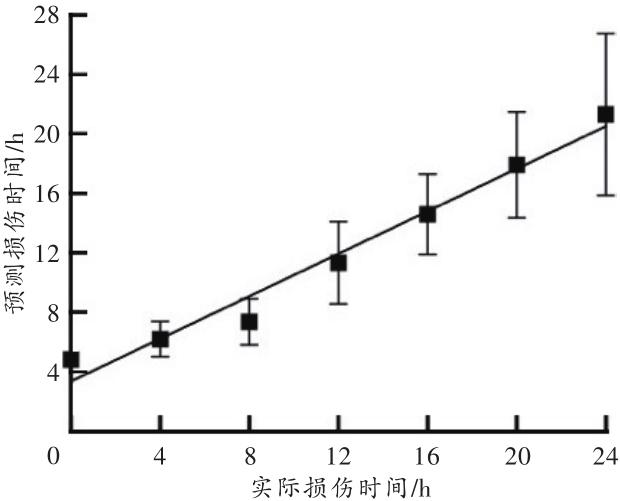
将验证组数据代入拟合的回归方程,损伤时间预测值的均值与实际值最小相差0.63 h,最大相差4.82 h(图1)。配对样本t检验结果显示,损伤时间预测值和实际值之间差异无统计学意义(P>0.05),证明建立的回归模型具有较好的预测能力,可用于损伤时间推断。
图1
3 讨 论
本研究应用RT-qPCR技术探讨大鼠骨骼肌Gpnmb mRNA表达随损伤时间、死亡时间和死后保存温度的变化规律,通过Pearson相关系数评价死亡时间、死后保存温度和损伤时间对Gpnmb mRNA表达的影响。结果表明,Gpnmb mRNA表达与死亡时间和死后保存温度不相关。因此,利用Gpnmb mRNA推断损伤时间受到死亡时间或尸体保存温度等死后因素的影响较小或基本无影响。在此基础上进一步研究发现,Gpnmb mRNA在骨骼肌损伤后呈持续上调的表达模式,与损伤时间呈线性关系,建立的回归模型为y=0.611 x+4.489,方差齐。通过回代检验可知,外部验证预测值与实际值最小相差0.63 h,最大相差4.82 h,模型预测较准确。因此,从本实验结果来看,Gpnmb mRNA表达量与损伤时间有很强的正相关性,即随着损伤时间的延长,Gpnmb mRNA的表达也随之增高,并且在死后24 h内可以保持较高的稳定性,降解速率也几乎不受温度变化的影响。
已有研究证实,CAPN5、VEGFA、HAF等多种mRNA的表达随死亡时间呈规律性变化[17,22];当温度升高时,CDC25B、ACTB、GAPDH等mRNA的稳定性降低,且随着死亡时间的延长明显降解[23-24]。但也有研究[23]报道,在不同温度影响下,Rpl27、Copb1、Rbfox1等mRNA在死后24 h内基本无变化,但这些研究均未考虑大鼠不同损伤时间对mRNA的影响。本研究对3种因素综合考虑,将不同损伤时间的大鼠处死后在0 ℃、16 ℃和26 ℃ 3个温度下保存24 h,发现Gpnmb mRNA的表达几乎不受死亡时间和死后保存温度的影响,而仅与损伤时间相关,这一点极其有利于生前损伤时间推断。该结果进一步提示科研工作者在后期筛选用于损伤时间推断的指标时,应尽量选取不受死亡时间和死后保存温度干扰的指标,从而简化损伤时间推断的问题。
本研究采用线性回归模型探索Gpnmb mRNA表达在损伤时间推断中的应用,但是此模型较简单,在数据信息的挖掘以及预测能力方面稍显不足。因此,在后续的损伤时间推断研究中,应使用多基因联合推断损伤时间,采用机器学习算法等建立更为可靠的指标评价体系,剔除其他对损伤时间推断影响较大的指标,筛查与损伤时间高度相关的mRNA指标,从而对损伤时间作出更为准确的预测。
参考文献
大鼠骨骼肌损伤修复中FZD4时序性变化及其应用
[J].
Time-dependent expression of FZD4 in contused skeletal muscle of rat used for wound age estimation
[J].
Temporal expression of wound healing-related genes inform wound age estimation in rats after a skeletal muscle contusion: A multivariate statistical model analysis
[J].
早期死亡时间推断研究进展
[J].
Research progress on estimation of early postmortem interval
[J].
大鼠死后脑组织RNA降解与死亡时间推断的研究
[J].
A pilot study on cerebral RNA degradation and its applicability to estimation of postmortem interval in rats
[J].
Exploration of the R code-based mathematical model for PMI estimation using profiling of RNA degradation in rat brain tissue at different temperatures
[J].
Research progress in the estimation of the postmortem interval by Chinese forensic scholars
[J].
Glycoprotein non-metastatic melanoma protein b (Gpnmb) is highly expressed in macrophages of acute injured kidney and promotes M2 macrophages polarization
[J].
Expression and immunolocalization of Gpnmb, a glioma-associated glycoprotein, in normal and inflamed central nervous systems of adult rats
[J].
Time-dependent expression of skeletal muscle troponin I mRNA in the contused skeletal muscle of rats: A possible marker for wound age estimation
[J].
双内参基因用于大鼠挫伤肌肉TAB2 mRNA表达量检测
[J].
Application of multiple reference genes for TAB2 mRNA expression in rat skeletal muscle
[J].
Analysis of sensitivity and specificity: Precise recognition of neutrophils during regeneration of contused skeletal muscle in rats
[J].
Vitality and wound-age estimation in forensic pathology: Review and future prospects
[J].
不同功能基因mRNA推断损伤时间的指标同质性
[J].
Homogeneity of different functional mRNA indicators for wound age estimation
[J].
大鼠骨骼肌挫伤后Fzd2表达与损伤时间的关系
[J].
Relationship between wound age and the expression of Fzd2 in rats skeletal muscle after contusion
[J].
Estimation of the time since death in the early post-mortem period
[J].
mRNA degradation controls differentiation state-dependent differences in transcript and splice variant abundance
[J].
Systematic analysis of gene expression patterns associated with postmortem interval in human tissues
[J].
Emerging therapeutic targets in breast cancer bone metastasis
[J].
大鼠骨骼肌损伤后PMN、MNC及FBC百分率与损伤时间关系
[J].
Correlation between percentages of PMN, MNC, FBC and wound age after skeletal muscle injury in rats
[J].
Expression of osteoactivin in rat and human liver and isolated rat liver cells
[J].
Validating glycoprotein non-metastatic melanoma B (gpNMB, osteoactivin), a new biomarker of Gaucher disease
[J].
Postmortem interval (PMI) determination by profiling of HAF mRNA degradation using RT-qPCR
[J].
Early postmortem interval estimation based on Cdc25b mRNA in rat cardiac tissue
[J].
RNA degradation as described by a mathematical model for postmortem interval determination
[J].


