法医学杂志 ›› 2026, Vol. 42 ›› Issue (4): 295-301.DOI: 10.12116/j.issn.1004-5619.2024.440903

• 论著 •    下一篇

基于微生物组学的乙醇联合CO中毒大鼠死亡时间预测

贾娟1,2(), 张君1,2, 章雯1,2, 张枫林3, 贠克明1,2(), 严江伟1,2()   

  1. 1.山西医科大学法医学院,山西 晋中 030600
    2.法庭毒物分析公安部重点实验室,山西 晋中 030600
    3.济南市公安局章丘分局,山东 济南 250200
  • 收稿日期:2024-09-05 发布日期:2026-10-28 出版日期:2026-08-25
  • 通讯作者: 贠克明,严江伟
  • 作者简介:贾娟(1978—),女,博士,副教授,副主任法医师,硕士研究生导师,主要从事基于多组学技术的法医毒理学研究;E-mail:jiajuan@sxmu.edu.cn
  • 基金资助:
    国家自然科学基金资助项目(82030058);国家自然科学基金资助项目(82130056)

Microbiomics‑Based Prediction of Postmortem Interval in Rats with Ethanol Exposure Combined with CO Poisoning

Juan Jia1,2(), Jun Zhang1,2, Wen Zhang1,2, Fenglin Zhang3, Keming Yun1,2(), Jiangwei Yan1,2()   

  1. 1.School of Forensic Medicine, Shanxi Medical University, Jinzhong 030600, Shanxi Province, China
    2.Key Laboratory of Forensic Toxicology, Ministry of Public Security, Jinzhong 030600, Shanxi Province, China
    3.Zhangqiu Branch of Jinan Public Security Bureau, Jinan 250200, China
  • Received:2024-09-05 Online:2026-10-28 Published:2026-08-25
  • Contact: Keming Yun, Jiangwei Yan

摘要:

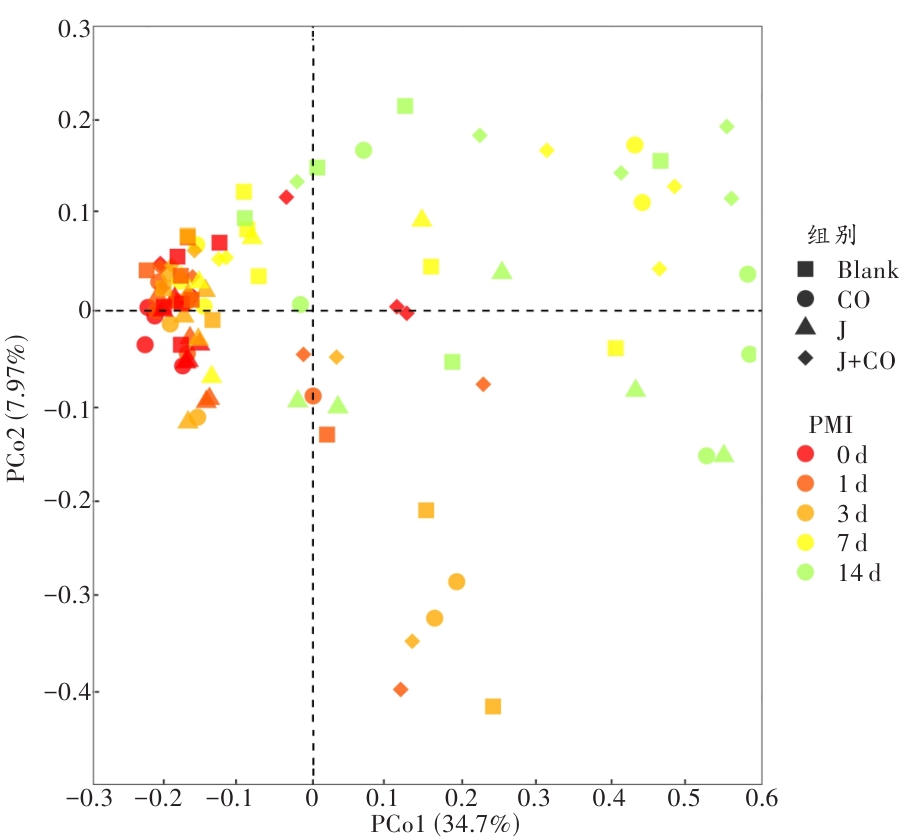
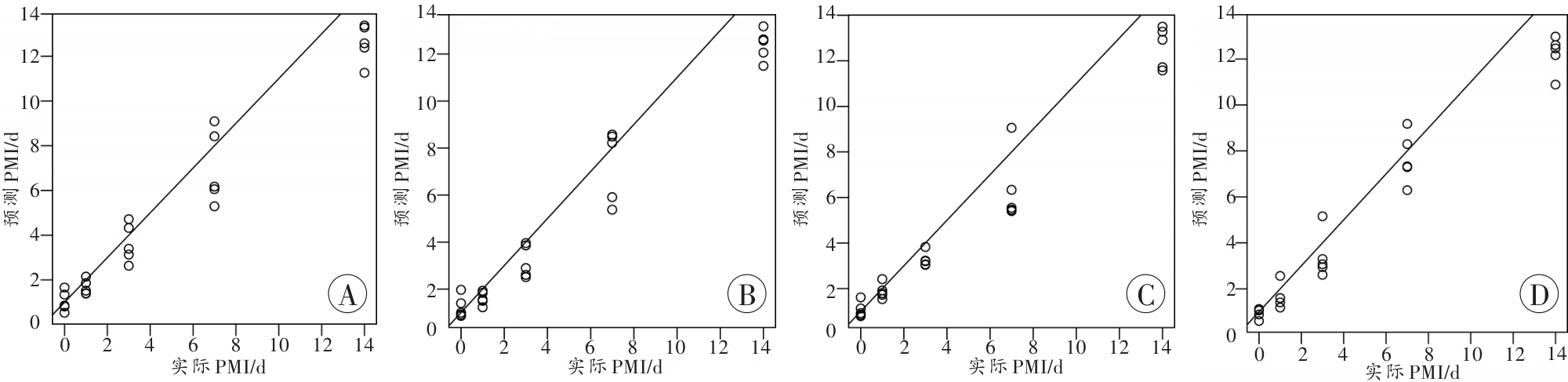
目的 采用微生物组学分析技术,研究乙醇联合一氧化碳(carbon monoxide,CO)中毒大鼠死后肠道细菌群落结构的演变规律,并探讨该变化与死亡时间(postmortem interval,PMI)之间的联系。 方法 建立CO中毒致死、乙醇暴露后CO中毒致死、单纯乙醇暴露、空白对照组的动物模型,分别于大鼠死后0、1、3、7、14 d取直肠标本。采用高通量测序技术对微生物16S rRNA基因进行测序,分析细菌群落的多样性、相对丰度和差异性,并利用随机森林算法构建基于细菌群落演变规律预测PMI的模型。 结果 各组大鼠死后14 d内肠道细菌群落的组成在门和属水平均发生改变。基于细菌群落特征的PMI预测模型在各组中均表现出良好的预测性能,CO中毒致死、乙醇暴露后CO中毒致死、单纯乙醇暴露、空白对照组的模型拟合度分别为0.60、0.59、0.61和0.60,平均误差均为1 d左右。 结论 CO中毒、乙醇联合CO中毒和乙醇摄入均会对大鼠尸体细菌群落结构的演变规律产生影响。在法医学实践中,针对此类特定中毒案例进行PMI推断时,建议采用为其专门构建的预测模型,以有效提高推断的准确性。

关键词: 法医病理学, 微生物组学, 一氧化碳中毒, 乙醇中毒, 死亡时间推断, 大鼠

Abstract:

Objective To investigate the temporal changes of intestinal bacterial communities in rats that died from combined ethanol and carbon monoxide (CO) poisoning using microbiome analysis techniques, and to explore potential correlations between these changes and the postmortem interval (PMI). Methods Four experimental groups were established: fatal CO poisoning, fatal CO poisoning following ethanol exposure, ethanol exposure, and blank controls. Rectal specimens were collected at 0, 1, 3, 7, and 14 days postmortem. High-throughput sequencing of the 16S rRNA gene was employed to analyze bacterial communities. Bacterial diversity, relative abundance, and community differences were analyzed. A predictive model for PMI estimation using bacterial community succession patterns was constructed using a random forest algorithm. Results The intestinal bacterial community structure of rats changed at both the phylum and genus levels within 14 days postmortem in the experimental groups. The PMI estimation model based on bacterial characteristics demonstrated good predictive performance across different experimental groups, with model fitting accuracies of 0.60, 0.59, 0.61 and 0.60 for each of the four groups. The average prediction error across all groups was approximately 1 day. Conclusion Ethanol exposure, CO poisoning, and the combined effects of ethanol exposure and CO poisoning all affect postmortem bacterial succession in rat cadavers. In forensic practice, it is recommended to adopt a predictive model specifically developed for the corresponding poisoning condition to improve the accuracy of PMI estimation.

Key words: forensic pathology, microbiomics, carbon monoxide poisoning, ethanol poisoning, postmortem interval estimation, rats

中图分类号: