法医学杂志 ›› 2026, Vol. 42 ›› Issue (2): 87-93.DOI: 10.12116/j.issn.1004-5619.2025.450505

• 论著 •    下一篇

联合肠道特征菌与机器学习的裸鼠死亡时间分段推断模型构建

张祥彦1(), 杨帆2, 胡胜2, 贾琼3, 聂昊2, 赵兴春2(), 郭亚东1()   

  1. 1.中南大学湘雅基础医学院法医学系,湖南 长沙 410013
    2.公安部鉴定中心,北京 100038
    3.中国人民公安大学,北京 100038
  • 收稿日期:2025-05-11 发布日期:2026-07-08 出版日期:2026-04-25
  • 通讯作者: 赵兴春,郭亚东
  • 作者简介:张祥彦(1996—),男,畲族,博士研究生,主要从事法医病理学研究;E-mail:942983987@qq.com
  • 基金资助:
    国家自然科学基金面上项目(82471922);公安部科技强警基础工作专项(2023JC17);法医病理学公安部重点实验室开放课题资助项目(GAFYBL202401)

Construction of a Segmented PMI Estimation Model Integrating Intestinal Microbial Signatures and Machine Learning in Nude Mice

Xiangyan ZHANG1(), Fan YANG2, Sheng HU2, Qiong JIA3, Hao NIE2, Xingchun ZHAO2(), Yadong GUO1()   

  1. 1.Department of Forensic Medicine, Xiangya School of Basic Medical Sciences, Central South University, Changsha 410013, China
    2.Institute of Forensic Science, Ministry of Public Security, Beijing 100038, China
    3.People’s Public Security University of China, Beijing 100038, China
  • Received:2025-05-11 Online:2026-07-08 Published:2026-04-25
  • Contact: Xingchun ZHAO, Yadong GUO

摘要:

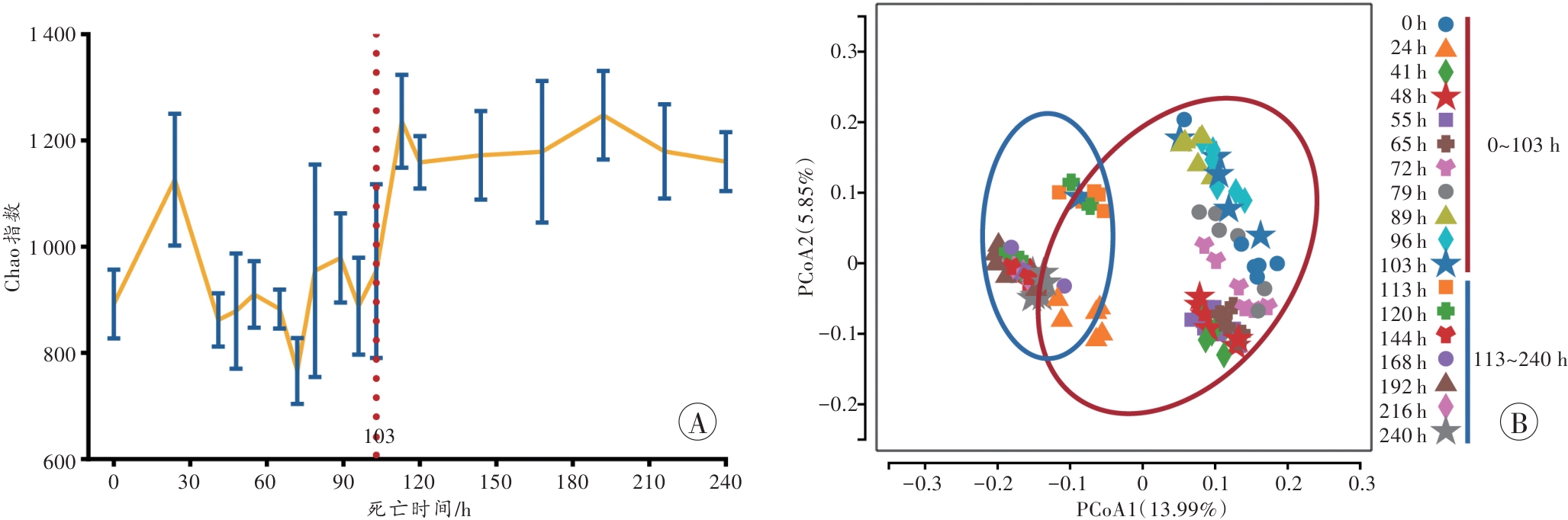
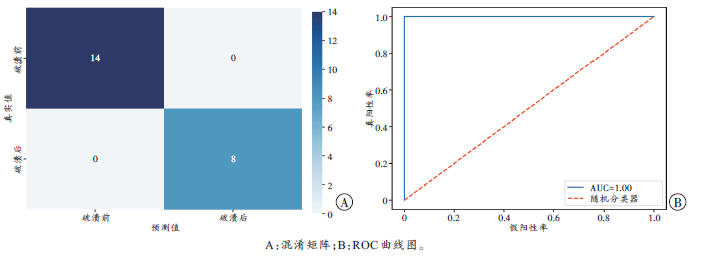
目的 观察裸鼠死后肠道菌群的阶段性变化,并基于“破溃点”构建裸鼠死亡时间推断模型,探索死亡时间推断新模型。 方法 将108只裸鼠处死后,于18个时间点(死后0、24、41、48、55、65、72、79、89、96、103、113、120、144、168、192、216和240 h)采集盲肠内容物,通过16S rRNA基因扩增子测序技术明确菌群变化。基于菌群丰度,采用随机森林模型进行交叉验证,筛选特征菌属,构建分段回归模型推断死亡时间,并与直接回归模型进行比较。 结果 α多样性和β多样性分析均提示死后0~103 h和113~240 h的裸鼠肠道菌群相对丰度差异显著。基于随机森林算法构建的分段回归模型推断死亡时间的R2为0.96,平均绝对误差为9.83 h;而直接回归模型推断死亡时间的R2为0.81,平均绝对误差为16.91 h。 结论 尸体腐败过程中的微生物演替具有时序性和阶段性特征,以“破溃点”为界构建的裸鼠死亡时间分段回归模型可提升死亡时间推断的准确性。

关键词: 法医病理学, 死亡时间推断, 肠道菌群, 机器学习, 分段回归模型, 裸鼠

Abstract:

Objective To observe stage-specific changes in the intestinal microbiota of nude mice after death and to develop a postmortem interval (PMI) estimation model based on “rupture points”, thereby exploring a new model for PMI estimation. Methods A total of 108 nude mice were sacrificed, and cecal contents were collected at 18 time points (0, 24, 41, 48, 55, 65, 72, 79, 89, 96, 103, 113, 120, 144, 168, 192, 216, and 240 h postmortem). 16S rRNA gene amplicon sequencing was used to analyze the changes in intestinal microbiota. Based on microbial abundance, a random forest model was employed for cross-validation to identify signature bacterial genera. A segmented regression model was then constructed to estimate PMI and compared with a direct regression model. Results Both α- diversity and β-diversity analyses indicated significant changes in the relative abundance of intestinal microbiota during the periods of 0-103 h and 113-240 h postmortem in nude mice. The segmented regression model built using the random forest algorithm achieved an R2 of 0.96 and a mean absolute error (MAE) of 9.83 h for PMI estimation. In contrast, the direct regression model yielded an R2 of 0.81 and an MAE of 16.91 h. Conclusion Microbial succession during cadaver decomposition exhibits clear temporal and stage-specific characteristics. A segmented regression model for PMI estimation using “rupture points” can improve the accuracy of PMI estimation in nude mice.

Key words: forensic pathology, postmortem interval estimation, intestinal microbiota, machine learning, segmented regression model, nude mice

中图分类号: