法医学杂志 ›› 2026, Vol. 42 ›› Issue (3): 247-253.DOI: 10.12116/j.issn.1004-5619.2025.450706

• 论著 • 上一篇    下一篇

多器官同步连续温度检测在尸温变化分析中的应用

卢江寰(), 马一新, 段智奥, 覃小诗, 周云超, 陈建华, 邓建强()   

  1. 海南医科大学基础医学院 热带转化医学教育部重点实验室 海南省热带法医学司法鉴定工程研究中心,海南 海口 571199
  • 收稿日期:2025-07-28 发布日期:2026-09-09 出版日期:2026-06-25
  • 通讯作者: 邓建强
  • 作者简介:卢江寰(2000—),男,硕士研究生,主要从事法医病理学研究;E-mail:lujh1127@163.com
  • 基金资助:
    国家自然科学基金资助项目(82060341);海南省院士创新平台科研项目资助项目(YSPTZX202134);海南医科大学研究生创新课题资助项目(HYYB2024-S012)

Application of Multi-Organ Synchronous Continuous Temperature Monitoring in the Analysis of Postmortem Temperature Changes

Jianghuan LU(), Yixin MA, Zhiao DUAN, Xiaoshi QIN, Yunchao ZHOU, Jianhua CHEN, Jianqiang DENG()   

  1. Key Laboratory of Tropical Translational Medicine of Ministry of Education, Hainan Provincial Engineering Research Center of Tropical Forensic Medicine, School of Basic Medical Sciences, Hainan Medical University, Haikou 577119, China
  • Received:2025-07-28 Online:2026-09-09 Published:2026-06-25
  • Contact: Jianqiang DENG

摘要:

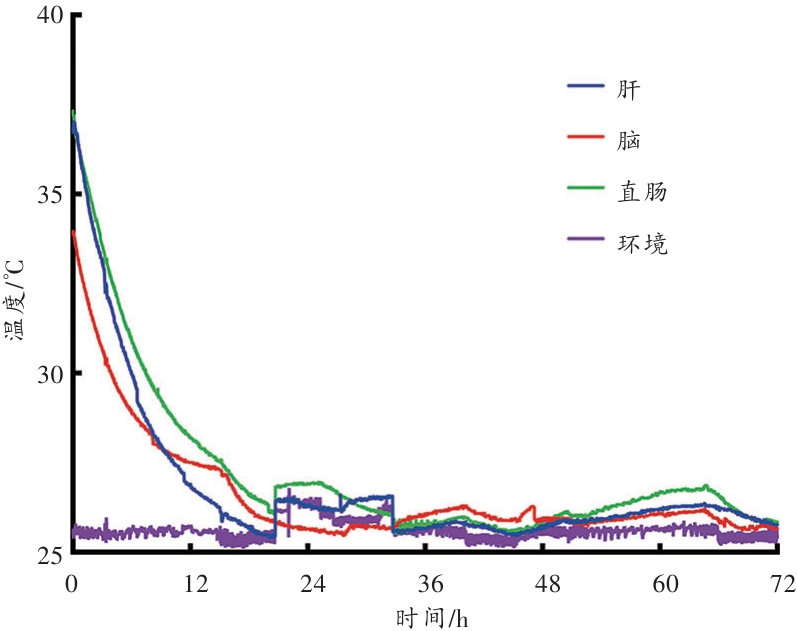
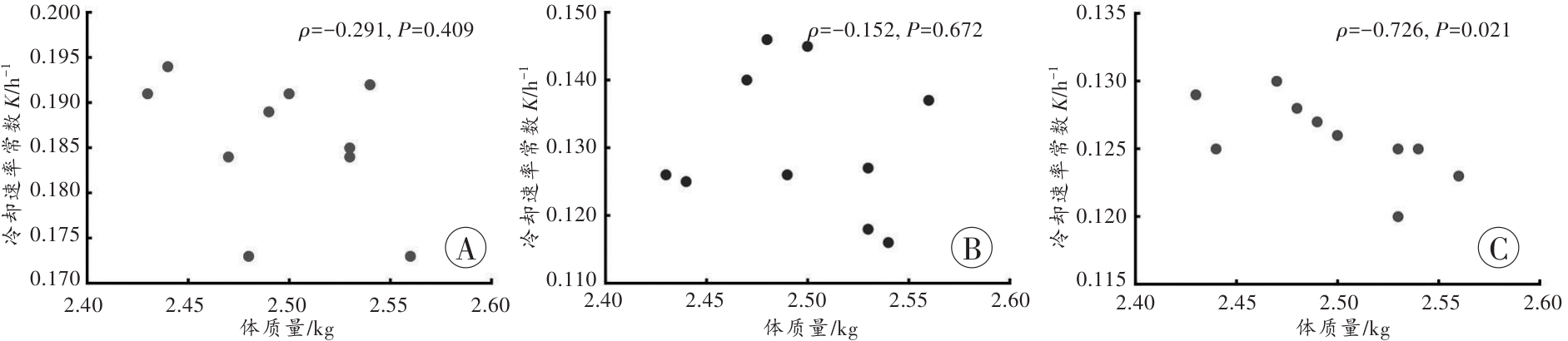
目的 对多器官同步连续温度监测,比较不同时间间隔断续取点温度与连续温度记录之间的误差,并分析不同测温器官尸温差的冷却动力学特征。 方法 在恒温25.4 ℃的人工气候箱内,同步72 h连续记录10只成年雄性家兔肝、脑、直肠及环境的温度。以各器官温度与同批次同一时刻环境温度之差的绝对值≤0.5 ℃作为接近环境温度的判定标准,记录各测温器官首次满足该标准的时刻。以直肠温度为分析对象,从尸温进入低温差阶段后的12 h连续记录温度中,分别按1、2、3和4 h的时间间隔断续提取直肠温度及对应的环境温度,并采用线性插值恢复至与原始连续记录相同的1 min时间分辨率,计算各插值恢复后的断续取点温度与原始连续温度记录之间的平均绝对误差(mean absolute error,MAE)和均方根误差(root mean square error,RMSE)。对死后0~12 h肝、脑及直肠尸温差进行一级动力学线性回归分析,计算冷却速率常数K、决定系数R2及尸温差半衰期t1/2,并采用Spearman秩相关分析检验体质量与各测温器官冷却速率常数K的关系。 结果 10只家兔肝、脑及直肠首次接近环境温度的时间分别为(15.41±0.97)h、(18.31±0.76)h和(21.13±2.21)h。随着断续取点的间隔时间由1 h延长至4 h,MAE由(0.094±0.028)℃增加至(0.176±0.045)℃,RMSE由(0.126±0.034)℃增加至(0.230±0.062)℃。死后0~12 h内,肝、脑及直肠的冷却速率常数K分别为(0.186±0.007)h-1、(0.131±0.011)h-1和(0.126±0.003)h-1,决定系数R2均值为0.977 4~0.997 0,尸温差半衰期t1/2分别为(3.740±0.154)h、(5.342±0.436)h和(5.514±0.129)h。体质量与直肠冷却速率K呈负相关(ρ=-0.726,P<0.05)。 结论 多器官同步连续温度监测能够记录尸体各器官温度冷却及接近环境温度后的波动过程。肝、脑和直肠首次接近环境温度的时间及尸温差冷却动力学参数呈现不同的数值特征;断续取点间隔时间延长会增加插值恢复后的断续取点与原始连续记录温度之间的误差。

关键词: 法医病理学, 尸温, 连续测温, 死亡时间推断, 家兔

Abstract:

Objective To compare the errors between data obtained by interval sampling at different time intervals and continuous temperature records, and to analyze the cooling kinetic characteristics of postmortem temperature differences at different measurement organs by monitoring multi-organ synchronous continuous temperatures. Methods Liver, brain, rectal, and ambient temperatures were synchronously and continuously recorded for 72 h in 10 adult male rabbits placed in a climate chamber maintained at 25.4 ℃. A measurement organ was considered to have approached ambient temperature when the absolute difference between the site temperature and the ambient temperature at the corresponding time point within the same batch was ≤0.5 ℃. The time at which each organ first met this criterion was recorded. Rectal temperature, a commonly used measurement in forensic practice, was selected for the interval-sampling analysis. From the 12 h continuous temperature record obtained after each rabbit entered the low temperature-difference stage, rectal and corresponding ambient temperatures were obtained at intervals of 1, 2, 3, and 4 h. Linear interpolation was then used to reconstruct each sampled dataset on the same 1-min time axis as the original record. The mean absolute error (MAE) and root mean square error (RMSE) between each interpolated series and the original continuous rectal temperature-difference record were calculated. Postmortem temperature differences in the liver, brain, and rectum during 0-12 h after death were analyzed according to a first-order kinetic model and analyzed by linear regression to calculate the cooling rate constant K, coefficient of determination R², and half-life of postmortem temperature difference t1/2. Spearman rank correlation analysis was used to examine the relationship between body mass and the K value at each measurement site. Results The first times at which the liver, brain, and rectum approached ambient temperature were (15.41±0.97)h, (18.31±0.76)h, and (21.13±2.21)h, respectively. As the interval between sampled time points increased from 1 to 4 h, the MAE increased from (0.094±0.028)℃ to (0.176±0.045)℃, and the RMSE increased from (0.126±0.034)℃ to (0.230±0.062)℃. During 0-12h after death, the K values of the liver, brain, and rectum were (0.186±0.007)h-1, (0.131±0.011)h-1, and (0.126±0.003)h-1, respectively. The mean R2 values ranged from 0.977 4 to 0.997 0 and the corresponding t1/2 values of the postmortem temperature differences were (3.740±0.154)h, (5.342±0.436)h, and (5.514±0.129)h, respectively. The body mass was negatively correlated with the rectal K value (ρ=-0.726, P<0.05). Conclusion Multi-organ synchronous continuous temperature monitoring enables continuous recording of the cooling process and subsequent temperature fluctuations of different organs after they approach ambient temperature. The liver, brain, and rectum show different numerical characteristics in the time required to first approach ambient temperature and in the cooling kinetic parameters of postmortem temperature difference. Prolonged sampling intervals increase the errors between the interpolated discrete temperature data and the original continuous records.

Key words: forensic pathology, cadaver temperature, continuous temperature monitoring, postmortem interval estimation, rabbits

中图分类号: