法医学杂志

• 论著 •    

新型合成大麻素AFUBIATA的定性分析

马镇川1,2(), 李涛1, 刘雪燕2, 杜宇3, 贾薇1, 花镇东1, 刘翠梅1()   

  1. 1.公安部禁毒情报技术中心 毒品监测管控与禁毒关键技术公安部重点实验室,北京 100193
    2.中国药科大学药学院,江苏 南京 211198
    3.江苏省公安厅毒品检测化验中心,江苏 南京 210024
  • 收稿日期:2024-05-10 发布日期:2026-10-03 出版日期:2026-08-25
  • 通讯作者: 刘翠梅
  • 作者简介:马镇川(2000—),男,硕士,主要从事毒品和新精神活性物质分析研究;E-mail:cpu_mzc@126.com

Qualitative Analysis of the Novel Synthetic Cannabinoid AFUBIATA

Zhenchuan MA1,2(), Tao LI1, Xueyan LIU2, Yu DU3, Wei JIA1, Zhendong HUA1, Cuimei LIU1()   

  1. 1.Key Laboratory of Drug Monitoring and Control, Drug Intelligence and Forensic Center, Ministry of Public Security, Beijing 100193, China
    2.School of Pharmacy, China Pharmaceutical University, Nanjing 211198, China
    3.Anti-Drug Technology Laboratory of Jiangsu Provincial Public Security Department, Nanjing 210024, China
  • Received:2024-05-10 Online:2026-10-03 Published:2026-08-25
  • Contact: Cuimei LIU

摘要:

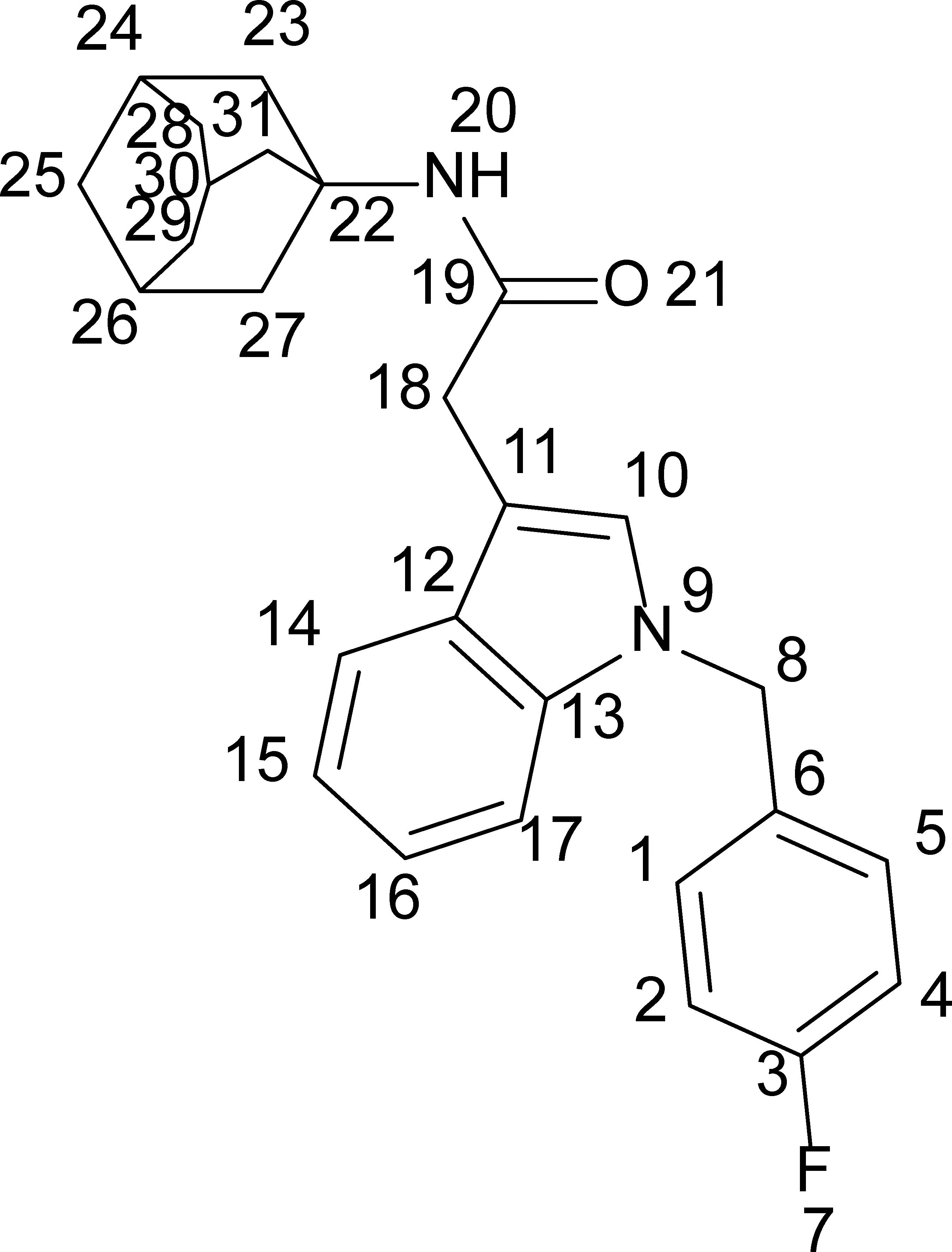
目的 研究无对照品时未知结构合成大麻素的定性分析策略。 方法 采用柱层析对可疑样品进行纯化,得到高纯度制备样品。综合利用GC-MS、超高效液相色谱-四极杆飞行时间质谱(ultra-high performance liquid chromatography-quadrupole time-of-flight mass spectrometry,UPLC-QTOF-MS)、核磁共振波谱(nuclear magnetic resonance spectroscopy,NMR)对制备样品进行分析,对比UPLC-QTOF-MS的碰撞诱导解离(collision-induced dissociation,CID)和电子活化解离(electron-activated dissociation,EAD)两种碎裂模式的差异,最终确证结构。 结果 通过柱层析纯化得到129.9 mg高纯度制备样品,利用GC-MS、UPLC-QTOF-MS和NMR综合分析,确证未知结构合成大麻素为N-(金刚烷-1-基)-2-[1-(4-氟苄基)-1H-吲哚-3-基]乙酰胺,英文简称AFUBIATA。通过比较CID和EAD两种裂解模式可知,EAD模式下可得到更丰富的碎片离子信息,有助于未知结构物质的解析。 结论 通过柱层析纯化可获得高纯度样品,综合利用GC-MS、UPLC-QTOF-MS和NMR信息,实现了未知合成大麻素的结构解析。

关键词: 法医学, 毒物分析, 合成大麻素类, N-(金刚烷-1-基)-2-[1-(4-氟苄基)-1H-吲哚-3-基]乙酰胺, 气相色谱-质谱法, 超高效液相色谱-四极杆飞行时间质谱法, 核磁共振波谱法

Abstract:

Objective To investigate a strategy for the qualitative analysis of synthetic cannabinoids with unknown structures in the absence of reference standards. Methods Column chromatography was used to purify the suspicious sample and obtain high-purity prepared sample. The prepared sample was analyzed and its structure was confirmed by comprehensive use of gas chromatography-mass spectrometry (GC-MS), ultra-high performance liquid chromatography quadrupole time-of-flight mass spectrometry (UPLC-QTOF-MS), and nuclear magnetic resonance spectroscopy (NMR). The differences between collision-induced dissociation (CID) and electron-activated dissociation (EAD) fragmentation modes of UPLC-QTOF-MS were compared, and the structure was finally confirmed. Results A 129.9 mg high-purity prepared sample was obtained through column chromatography. Through comprehensive analysis of GC-MS, UPLC-QTOF-MS, and NMR, it was confirmed that the unknown synthesized cannabinoid was N-(adamantane-1-yl)-2-[1-(4-fluorobenzyl)-1H-indole-3-yl]acetamide, abbreviated as AFUBIATA. Comparison of the CID and EAD fragmentation modes revealed that the EAD provided richer fragment ion information, which facilitated the structural elucidation of the unknown substance. Conclusion This study obtained a high-purity sample through column chromatography. By comprehensively utilizing GC-MS, UPLC-QTOF-MS and NMR information, the structural elucidation of unknown synthetic cannabinoids was achieved. This information can assist forensic science laboratories in identifying this substance or similar structural compounds.

Key words: forensic medicine, toxicological analysis, synthetic cannabinoids, N-(adamantan-1-yl)-2-(1-(4-fluorobenzyl)-1H-indol-3-yl)acetamide (AFUBIATA), gas chromatography-mass spectrometry (GC-MS), ultra-high performance liquid chromatography-quadrupole time-of-flight mass spectrometry (UPLC-QTOF-MS), nuclear magnetic resonance spectroscopy (NMR)

中图分类号: