
Journal of Forensic Medicine ›› 2026, Vol. 42 ›› Issue (2): 112-120.DOI: 10.12116/j.issn.1004-5619.2025.550701
• Original Articles • Previous Articles Next Articles
Jinyuan ZHAO1,2( ), Yujia XUAN1,2, Anqi CHEN2, Yanfang LU2, Mengxiao LIAO2, Sitong LIU2, Yu XING1,2, Yali WANG1, Liqin CHEN1(), Chengtao LI1,2,3()
Received:2025-07-04
Online:2026-07-08
Published:2026-04-25
Contact:
Liqin CHEN, Chengtao LI
CLC Number:
Jinyuan ZHAO, Yujia XUAN, Anqi CHEN, Yanfang LU, Mengxiao LIAO, Sitong LIU, Yu XING, Yali WANG, Liqin CHEN, Chengtao LI. Effect of RNA Sequencing Normalization on Forensic Age Estimation[J]. Journal of Forensic Medicine, 2026, 42(2): 112-120.
Add to citation manager EndNote|Ris|BibTeX
URL: http://www.fyxzz.cn/EN/10.12116/j.issn.1004-5619.2025.550701
| 年龄段/岁 | 男性 | 女性 | 合计 |
|---|---|---|---|
| 合计 | 73 | 74 | 147 |
| 18~30 | 15 | 15 | 30 |
| >30~40 | 11 | 12 | 23 |
| >40~50 | 11 | 12 | 23 |
| >50~60 | 13 | 11 | 24 |
| >60~70 | 10 | 12 | 22 |
| >70 | 13 | 12 | 25 |
Tab. 1 Age and sex distribution of the 147 samples
| 年龄段/岁 | 男性 | 女性 | 合计 |
|---|---|---|---|
| 合计 | 73 | 74 | 147 |
| 18~30 | 15 | 15 | 30 |
| >30~40 | 11 | 12 | 23 |
| >40~50 | 11 | 12 | 23 |
| >50~60 | 13 | 11 | 24 |
| >60~70 | 10 | 12 | 22 |
| >70 | 13 | 12 | 25 |
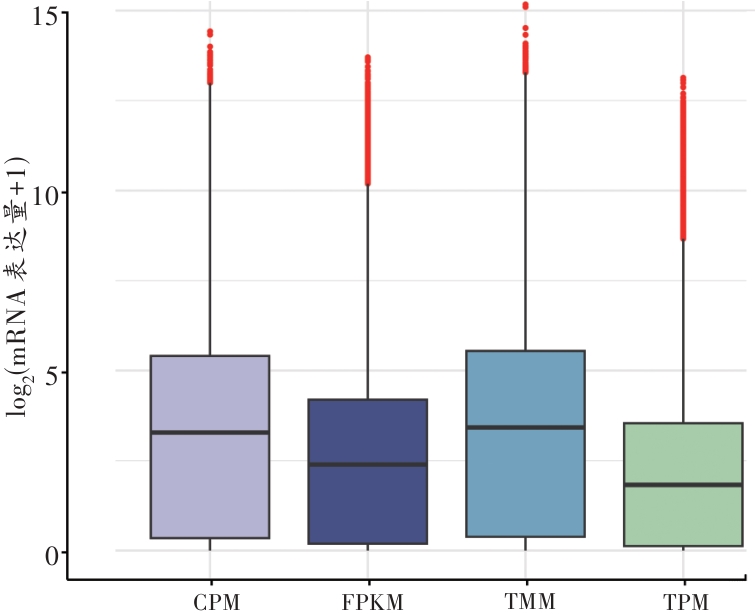
Fig. 1 Box plots of distribution of mRNA expressionlevels under four normalization methods
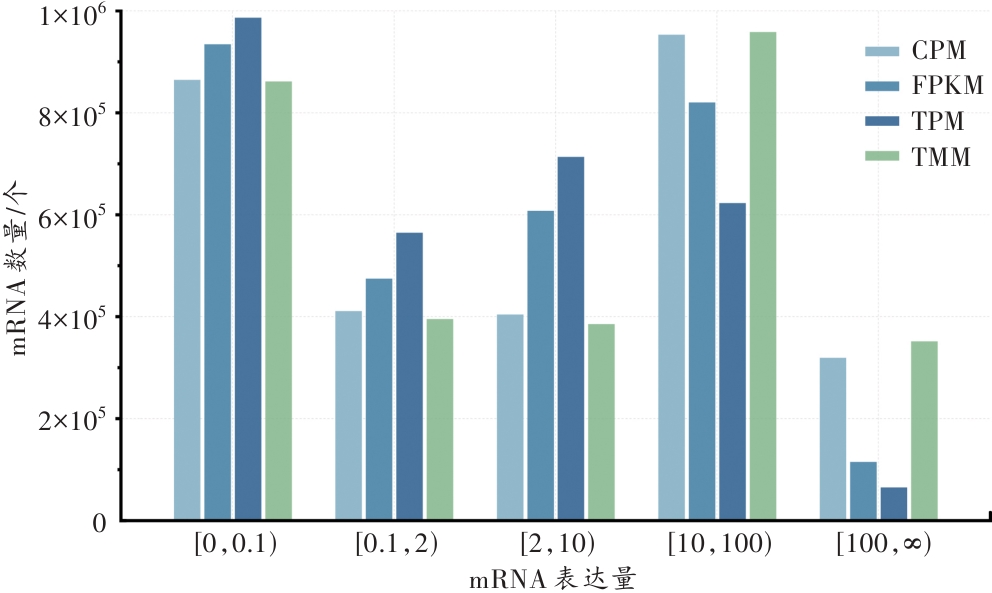
Fig. 2 Bar charts of grouped statistics of mRNA expressionlevels under four normalization methods
| 归一化方法 | 潜在年龄相关性mRNA数量 | KEGG通路数量 | 与已知通路重叠数量 |
|---|---|---|---|
| CPM | 2 897 | 14 | 3 |
| FPKM | 1 481 | 39 | 5 |
| TPM | 338 | 7 | 2 |
| TMM | 2 912 | 59 | 5 |
Tab. 2 Summary of potential age-related mRNAsscreened by four normalization methods andtheir KEGG enrichment analysis results
| 归一化方法 | 潜在年龄相关性mRNA数量 | KEGG通路数量 | 与已知通路重叠数量 |
|---|---|---|---|
| CPM | 2 897 | 14 | 3 |
| FPKM | 1 481 | 39 | 5 |
| TPM | 338 | 7 | 2 |
| TMM | 2 912 | 59 | 5 |
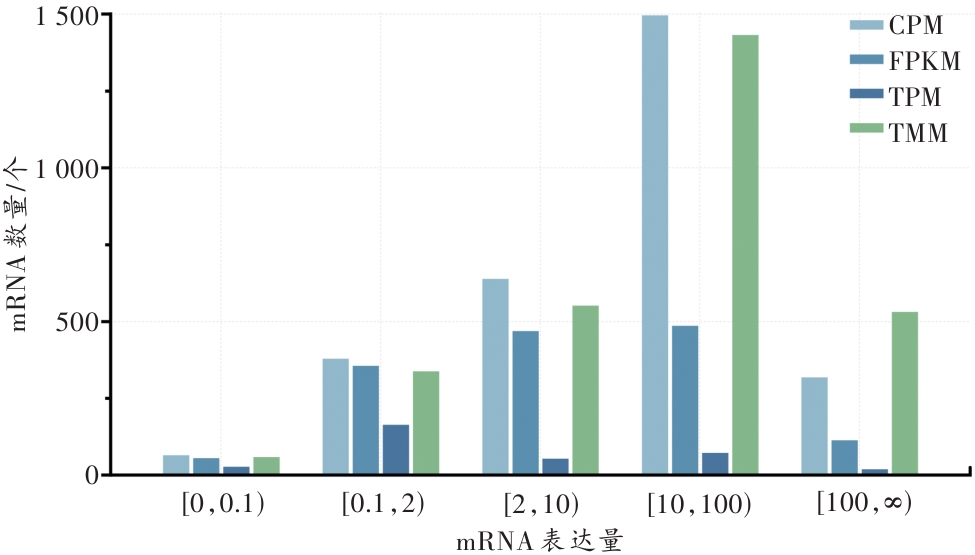
Fig. 3 Bar charts of interval distribution of age-relatedmRNA expression levels screened byfour normalization methods
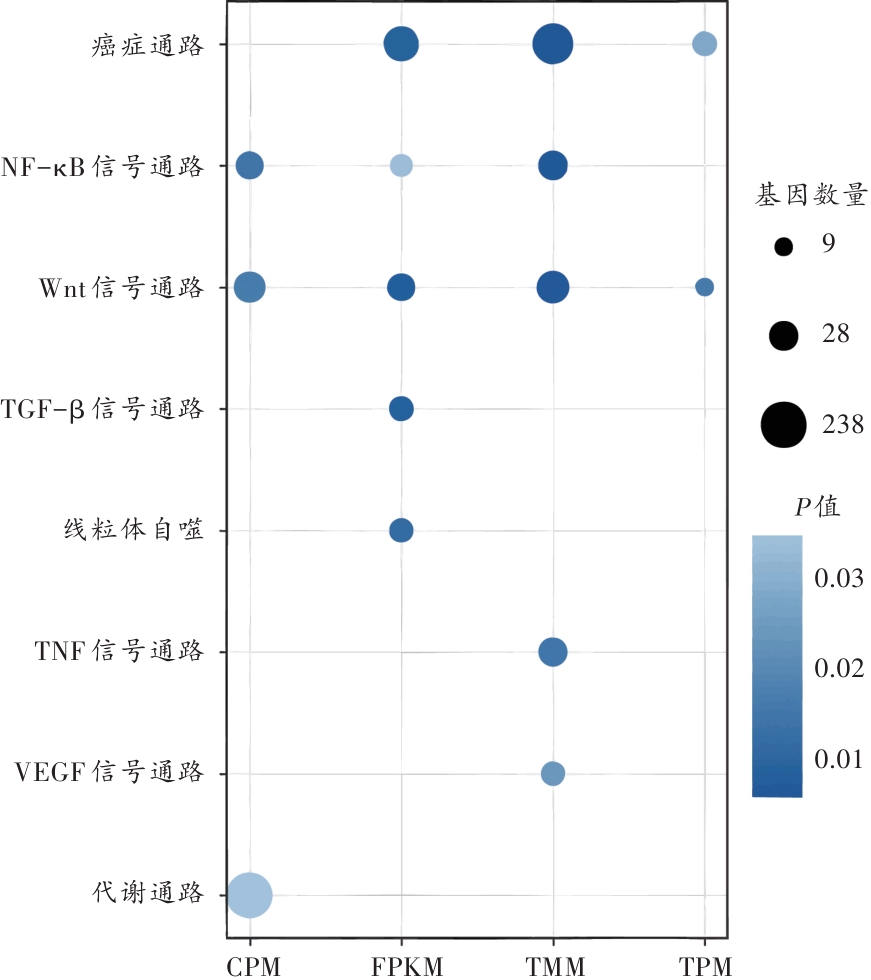
Fig. 4 Comparison of KEGG pathways betweenthe four normalization methods and the AgingAtlas database (bubble plot)
| 归一化方法 | LASSO | SVM | XGBoost | ||||||
|---|---|---|---|---|---|---|---|---|---|
| MAE/岁 | RMSE/岁 | R² | MAE/岁 | RMSE/岁 | R² | MAE/岁 | RMSE/岁 | R² | |
| CPM | 7.01 | 8.31 | 0.80 | 8.07 | 10.86 | 0.65 | 4.64 | 5.82 | 0.90 |
| FPKM | 7.74 | 9.12 | 0.75 | 8.55 | 10.99 | 0.64 | 4.97 | 6.35 | 0.88 |
| TPM | 8.12 | 9.73 | 0.72 | 8.62 | 10.67 | 0.66 | 5.86 | 7.38 | 0.84 |
| TMM | 4.75 | 6.15 | 0.89 | 7.17 | 9.34 | 0.74 | 4.38 | 5.28 | 0.92 |
Tab. 3 Predictive performance of three models constructed using four normalization methods on the training set
| 归一化方法 | LASSO | SVM | XGBoost | ||||||
|---|---|---|---|---|---|---|---|---|---|
| MAE/岁 | RMSE/岁 | R² | MAE/岁 | RMSE/岁 | R² | MAE/岁 | RMSE/岁 | R² | |
| CPM | 7.01 | 8.31 | 0.80 | 8.07 | 10.86 | 0.65 | 4.64 | 5.82 | 0.90 |
| FPKM | 7.74 | 9.12 | 0.75 | 8.55 | 10.99 | 0.64 | 4.97 | 6.35 | 0.88 |
| TPM | 8.12 | 9.73 | 0.72 | 8.62 | 10.67 | 0.66 | 5.86 | 7.38 | 0.84 |
| TMM | 4.75 | 6.15 | 0.89 | 7.17 | 9.34 | 0.74 | 4.38 | 5.28 | 0.92 |
| 归一化方法 | LASSO | SVM | XGBoost | ||||||
|---|---|---|---|---|---|---|---|---|---|
| MAE/岁 | RMSE/岁 | R2 | MAE/岁 | RMSE/岁 | R2 | MAE/岁 | RMSE/岁 | R2 | |
| CPM | 7.08 | 8.85 | 0.77 | 8.79 | 11.19 | 0.63 | 6.30 | 7.57 | 0.85 |
| FPKM | 8.22 | 10.12 | 0.69 | 9.04 | 11.65 | 0.59 | 7.11 | 9.68 | 0.77 |
| TPM | 8.64 | 10.63 | 0.66 | 9.29 | 11.21 | 0.62 | 7.16 | 9.09 | 0.78 |
| TMM | 6.59 | 8.11 | 0.80 | 8.04 | 10.02 | 0.70 | 5.85 | 7.31 | 0.87 |
Tab. 4 Predictive performance of three models constructed using four normalization methods on the test set
| 归一化方法 | LASSO | SVM | XGBoost | ||||||
|---|---|---|---|---|---|---|---|---|---|
| MAE/岁 | RMSE/岁 | R2 | MAE/岁 | RMSE/岁 | R2 | MAE/岁 | RMSE/岁 | R2 | |
| CPM | 7.08 | 8.85 | 0.77 | 8.79 | 11.19 | 0.63 | 6.30 | 7.57 | 0.85 |
| FPKM | 8.22 | 10.12 | 0.69 | 9.04 | 11.65 | 0.59 | 7.11 | 9.68 | 0.77 |
| TPM | 8.64 | 10.63 | 0.66 | 9.29 | 11.21 | 0.62 | 7.16 | 9.09 | 0.78 |
| TMM | 6.59 | 8.11 | 0.80 | 8.04 | 10.02 | 0.70 | 5.85 | 7.31 | 0.87 |
| [1] | 王亚辉,陈腾. 法医学活体年龄推断研究前沿与挑战[J].法医学杂志,2024,40(2):109-111. |
| doi:10.12116/j.issn.1004-5619.2024.240410.WANG Y H, CHEN T. Research frontiers and challenges of living age estimation in forensic science[J]. Fayixue Zazhi,2024,40(2):109-111. | |
| [2] | MARCANTE B, MARINO L, CATTANEO N E, et al. Advancing forensic human chronological age estimation: Biochemical, genetic, and epigenetic approaches from the last 15 years: A systematic review[J]. Int J Mol Sci,2025,26(7):3158. doi:10.3390/ijms26073158 . |
| [3] | 王郡颜,李淑瑾. 衰老相关生物分子标志物在法医年龄推断中的研究进展[J].中国法医学杂志,2023,38(1):69-74. doi:10.13618/j.issn.1001-5728.2023.01.013 . |
| WANG J Y, LI S J. Development of aged-related biomolecular markers for age inference in the field of forensic medicine[J]. Zhongguo Fayixue Zazhi,2023,38(1):69-74. | |
| [4] | 路艳芳,李成涛. 转录组分子在法医疑难检材鉴定的分子基础及其在年龄推断中的应用[J].中国法医学杂志,2025,40(1):90-95. doi:10.13618/j.issn.1001-5728.2025.01.016 . |
| LU Y F, LI C T. The molecular basis of transcriptome molecules in forensic identification of challenging samples and their application in age estimation[J]. Zhongguo Fayixue Zazhi,2025,40(1):90-95. | |
| [5] | WANG J Y, WANG C Y, WEI Y Y, et al. Circular RNA as a potential biomarker for forensic age prediction[J]. Front Genet,2022,13:825443. doi:10.3389/fgene.2022.825443 . |
| [6] | LU Y F, CHEN A Q, LIAO M X, et al. Development of a microRNA-based age estimation model using whole-blood microRNA expression profiling[J]. Noncoding RNA Res,2025,12:81-91. doi:10.1016/j.ncrna.2025.03.003 . |
| [7] | FANG C, ZHOU P, LI R, et al. Development of a novel forensic age estimation strategy for aged blood samples by combining piRNA and miRNA markers[J]. Int J Legal Med,2023,137(5):1327-1335. doi:10.1007/s00414-023-03028-8 . |
| [8] | JIN X Y, REN Z, ZHANG H L, et al. Systematic selection of age-associated mRNA markers and the development of predicted models for forensic age inference by three machine learning methods[J]. Front Genet,2022,13:924408. doi:10.3389/fgene.2022.924408 . |
| [9] | QUINN T P, CROWLEY T M, RICHARDSON M F. Benchmarking differential expression analysis tools for RNA-Seq: Normalization-based vs. log-ratio transformation-based methods[J]. BMC Bioinformatics,2018,19:274. doi:10.1186/s12859-018-2261-8 . |
| [10] | CONESA A, MADRIGAL P, TARAZONA S, et al. A survey of best practices for RNA-seq data analysis[J]. Genome Biol,2016,17:13. doi:10.1186/s13059-016-0881-8 . |
| [11] | EVANS C, HARDIN J, STOEBEL D M. Selecting between-sample RNA-Seq normalization methods from the perspective of their assumptions[J]. Brief Bioinform,2018,19(5):776-792. doi:10.1093/bib/bbx008 . |
| [12] | DÜZ E, ÇAKIR T. Effect of RNA-Seq data normalization on protein interactome mapping for Alzheimer’s disease[J]. Comput Biol Chem,2024,109:108028. doi:10.1016/j.compbiolchem.2024.108028 . |
| [13] | LI X H, COOPER N G F, O’TOOLE T E, et al. Choice of library size normalization and statistical methods for differential gene expression analysis in balanced two-group comparisons for RNA-seq studies[J]. BMC Genomics,2020,21:75. doi:10.1186/s12864-020-6502-7 . |
| [14] | LI X H, BROCK G N, ROUCHKA E C, et al. A comparison of per sample global scaling and per gene normalization methods for differential expression analysis of RNA-seq data[J]. PLoS One,2017,12(5):e0176185. doi:10.1371/journal.pone.0176185 . |
| [15] | LIN Y Z, GOLOVNINA K, CHEN Z X, et al. Comparison of normalization and differential expression analyses using RNA-Seq data from 726 individual Drosophila melanogaster [J]. BMC Genomics,2016,17:28. doi:10.1186/s12864-015-2353-z . |
| [16] | ELAHIMANESH M, NAJAFI M. Differentially expressed genes of RNA-seq data are suggested on the intersections of normalization techniques[J]. Biochem Biophys Rep,2024,37:101618. doi:10.1016/j.bbrep.2023.101618 . |
| [17] | TAM S, TSAO M S, MCPHERSON J D. Optimization of miRNA-seq data preprocessing[J]. Brief Bioinform,2015,16(6):950-963. doi:10.1093/bib/bbv019 . |
| [18] | ZHAO S R, YE Z, STANTON R. Misuse of RPKM or TPM normalization when comparing across sam-ples and sequencing protocols[J]. RNA,2020,26(8):903-909. doi:10.1261/rna.074922.120 . |
| [19] | ZHAO Y D, LI M C, KONATÉ M M, et al. TPM, FPKM, or normalized counts? A comparative study of quantification measures for the analysis of RNA-seq data from the NCI patient-derived models repository[J]. J Transl Med,2021,19(1):269. doi:10.1186/s12967-021-02936-w . |
| [20] | WAGNER G P, KIN K, LYNCH V J. Measurement of mRNA abundance using RNA-seq data: RPKM measure is inconsistent among samples[J]. Theor Biosci,2012,131(4):281-285. doi:10.1007/s12064-012-0162-3 . |
| [21] | ROBINSON M D, OSHLACK A. A scaling normalization method for differential expression analysis of RNA-seq data[J]. Genome Biol,2010,11(3):R25. doi:10.1186/gb-2010-11-3-r25 . |
| [22] | SHERMAN B T, HAO M, QIU J, et al. DAVID: A web server for functional enrichment analysis and functional annotation of gene lists (2021 update)[J]. Nucleic Acids Res,2022,50(W1):W216-W221. doi:10.1093/nar/gkac194 . |
| [23] | Aging Atlas Consortium. Aging Atlas: A multi-omics database for aging biology[J]. Nucleic Acids Res,2021,49(D1):D825-D830. doi:10.1093/nar/gkaa894 . |
| [24] | VARSHAVSKY M, HARARI G, GLASER B, et al. Accurate age prediction from blood using a small set of DNA methylation sites and a cohort-based machine learning algorithm[J]. Cell Rep Methods,2023,3(9):100567. doi:10.1016/j.crmeth.2023.100567 . |
| [25] | CHEN A Q, XUAN Y J, YANG F, et al. Long non-coding RNAs in human peripheral blood as biomarkers for age prediction[J]. Forensic Sci Int Genet,2026,82:103419. doi:10.1016/j.fsigen.2025.103419 . |
| [26] | 王郡颜. 外周血年龄相关性circRNAs分子标志物的筛选及法医学个体年龄推断模型的构建[D].石家庄:河北医科大学,2020. |
| WANG J Y. Identification of age-correlated circRNA markers for the development of forensic age estimation models[D]. Shijiazhuang: Hebei Medical University,2020. | |
| [27] | STOEGER T, GRANT R A, MCQUATTIE-PIMENTEL A C, et al. Aging is associated with a systemic length-associated transcriptome imbalance[J]. Nat Aging,2022,2(12):1191-1206. doi:10.1038/s43587-022-00317-6 . |
| [28] | 蔡美铭,陈曼,季观庆,等. 法医转录组学的研究进展及展望[J].中国法医学杂志,2023,38(2):166-171. doi:10.13618/j.issn.1001-5728.2023.02.014 . |
| CAI M M, CHEN M, JI G Q, et al. Research progress and prospect of forensic transcriptomics[J]. Zhongguo Fayixue Zazhi,2023,38(2):166-171. | |
| [29] | 樊嵘,孟大志,徐大舜. 统计相关性分析方法研究进展[J].数学建模及其应用,2014,3(1):1-12. doi:10.3969/j.issn.2095-3070.2014.01.002 . |
| FAN R, MENG D Z, XU D S. Survey of research process on statistical correlation analysis[J]. Shuxue Jianmo Jiqi Yingyong,2014,3(1):1-12. | |
| [30] | 谢文华. Spearman相关系数的变量筛选方法[D].北京:北京工业大学,2015. |
| XIE W H. Variable screening based on Spearman correlation[D]. Beijing: Beijing University of Technology,2015. | |
| [31] | KE T M, LOPHATANANON A, MUIR K R. Exploring the relationships between lifestyle patterns and epigenetic biological age measures in men[J]. Biomedicines,2024,12(9):1985. doi:10.3390/biomedicines12091985 . |
| [32] | ALSALEH H, HADDRILL P R. Identifying blood-specific age-related DNA methylation markers on the Illumina MethylationEPIC® BeadChip[J]. Forensic Sci Int,2019,303:109944. doi:10.1016/j.forsciint.2019.109944 . |
| [33] | 邢杨峰,冀志敏,李俊丽,等. 机器学习技术结合Y染色体CpG位点推断男性年龄[J].中国法医学杂志,2023,38(4):381-384,389. |
| doi:10.13618/j.issn.1001-5728.2023.04.010.XING Y F, JI Z M, LI J L, et al. Inferring male individual age based on machine learning technology and Y chromosome CpG locus[J]. Zhongguo Fayixue Zazhi,2023,38(4):381-384,389. | |
| [34] | SMID M, COEBERGH VAN DEN BRAAK R R J, VAN DE WERKEN H J G, et al. Gene length corrected trimmed mean of M-values (GeTMM) processing of RNA-seq data performs similarly in intersample analyses while improving intrasample comparisons[J]. BMC Bioinformatics,2018,19:236. doi:10.1186/s12859-018-2246-7 . |
| [35] | LÓPEZ-OTÍN C, PIETROCOLA F, ROIZ-VALLE D, et al. Meta-hallmarks of aging and cancer[J]. Cell Metab,2023,35(1):12-35. doi:10.1016/j.cmet.2022.11.001 . |
| [36] | HU H H, CAO G, WU X Q, et al. Wnt signaling pathway in aging-related tissue fibrosis and therapies[J]. Ageing Res Rev,2020,60:101063. doi:10 . |
| 1016/j.arr.2020.101063. | |
| [37] | HAGA M, OKADA M. Systems approaches to investigate the role of NF-κB signaling in aging[J]. Biochem J,2022,479(2):161-183. doi:10.1042/BCJ20210547 . |
| [38] | BAIRAKDAR M D, TEWARI A, TRUTTMANN M C. A meta-analysis of RNA-Seq studies to identify novel genes that regulate aging[J]. Exp Gerontol,2023,173:112107. doi:10.1016/j.exger.2023.112107 . |
| [39] | LÜLECI H B, UZUNER D, CESUR M F, et al. A benchmark of RNA-seq data normalization me-thods for transcriptome mapping on human genome-scale metabolic networks[J]. NPJ Syst Biol Appl,2024,10(1):124. doi:10.1038/s41540-024-00448-z . |
| [40] | WU Y T, GAO H J, ZHANG C, et al. Machine learning and deep learning approaches in lifespan brain age prediction: A comprehensive review[J]. Tomography,2024,10(8):1238-1262. doi:10.3390/tomography10080093 . |
| [41] | SHOKHIREV M N, JOHNSON A A. Modeling the human aging transcriptome across tissues, health status, and sex[J]. Aging Cell,2021,20(1):e13280. doi:10.1111/acel.13280 . |
| [42] | HAN H, MEN K. How does normalization impact RNA-seq disease diagnosis?[J]. J Biomed Inform,2018,85:80-92. doi:10.1016/j.jbi.2018.07.016 . |
| [43] | DØRUM G, HÄNGGI N V, BURRI D, et al. Selecting mRNA markers in blood for age estimation of the donor of a biological stain[J]. Forensic Sci Int Genet,2024,68:102976. doi:10.1016/j.fsigen.2023.102976 . |
| [44] | FLEISCHER J G, SCHULTE R, TSAI H H, et al. Predicting age from the transcriptome of human dermal fibroblasts[J]. Genome Biol,2018,19:221. doi:10.1186/s13059-018-1599-6 . |
| [45] | 朱波峰. 多组学视域下的精准鉴识:法医物证学研究现状、挑战与展望[J].法医学杂志,2025,41(5):421-440. doi:10.12116/j.issn.1004-5619.2025.550704 . |
| ZHU B F. Precision identification from a multi-omics perspective: Current status, challenges, and prospects in forensic genetics[J]. Fayixue Zazhi,2025,41(5):421-440. |
| [1] | Le YANG, He REN, Yan SHI, Chong CHEN, Li JIA, Qian YANG, Yacheng LIU, Jiangwei YAN. Empirical Classification of Tri-Allelic Genotype Cases and Parentage Index Calculation [J]. Journal of Forensic Medicine, 2026, 42(3): 254-260. |
| [2] | Gengqian ZHANG, Zidong LIU. Methods, Applications and Prospects of RNA Polymorphism for Individual Identification [J]. Journal of Forensic Medicine, 2026, 42(2): 143-150. |
| [3] | Zhenping LIU, Zhihua YE, Jijun TONG, Jiahui SONG, Weiwei WU, Honglei HAO, Yanfang FU, Xiandun ZHAI. Analysis of Abnormal Genotyping at Amelogenin Locus in Male Individuals [J]. Journal of Forensic Medicine, 2026, 42(2): 121-129. |
| [4] | Xiangyan ZHANG, Fan YANG, Sheng HU, Qiong JIA, Hao NIE, Xingchun ZHAO, Yadong GUO. Construction of a Segmented PMI Estimation Model Integrating Intestinal Microbial Signatures and Machine Learning in Nude Mice [J]. Journal of Forensic Medicine, 2026, 42(2): 87-93. |
| [5] | Run-ting DOU, Shun CHENG, Xin ZHOU, Xing YE, Zhi-min WANG, Guang-hui HONG, Qi ZHANG, Qing XIA, Yi-wen SHEN. Machine Learning Model Based on Structured Injury Features for Knee Mobility Discriminations after Traumatic Injury [J]. Journal of Forensic Medicine, 2026, 42(1): 8-16. |
| [6] | Yi-hua SUN, Jian CHEN, Yong-sheng LI. Comparison of the Forensic Testing Performance of Six STR Kits [J]. Journal of Forensic Medicine, 2026, 42(1): 26-33. |
| [7] | ZHU Bo-feng. Precision Identification from a Multi-omics Perspective: Current Status, Challenges, and Prospects in Forensic Genetics [J]. Journal of Forensic Medicine, 2025, 41(5): 421-440. |
| [8] | Hou-ying ZOU, Yin-lei LEI, Ruo-cheng XIA, Yan SHI, Cheng-tao LI. Exploring Microbial Detection of Psychoactive Substances in Wastewater Based on Micobiome Analysis [J]. Journal of Forensic Medicine, 2025, 41(5): 468-476. |
| [9] | Zi-wen GUO, Tian-yu QIU, Yue CAO. Rapid Identification of Etomidate and Its Structural Analogues Based on Surface-Enhanced Raman Spectroscopy and Machine Learning [J]. Journal of Forensic Medicine, 2025, 41(4): 364-370. |
| [10] | Jing CHEN, Ya-ping WANG, Yun-peng FENG, Xiao-xin HU, Zhen-jun JIA, Hong-di LIU, An-xin YAN, Yong-jiu LI, Zhu PENG, Zhi-fang LIU, Jian-gang CHEN. Validation and Forensic Application of a Domestic Human DNA Quantitative Detection Kit [J]. Journal of Forensic Medicine, 2025, 41(3): 252-259. |
| [11] | Ze-qin LI, Fang YUAN, Na LIU, Jiang-wei YAN, Geng-qian ZHANG. Dental Floss-derived Biological Sample Collection, DNA Extraction and STR Typing [J]. Journal of Forensic Medicine, 2025, 41(3): 237-243. |
| [12] | Hui-ming ZHOU, Dan-yang LI, Lei WAN, Tai-ang LIU, Yuan-zhe LI, Mao-wen WANG, Ya-hui WANG. Dual-Channel Shoulder Joint X-ray Bone Age Estimation in Chinese Han Adolescents Based on the Fusion of Segmentation Labels and Original Images [J]. Journal of Forensic Medicine, 2025, 41(3): 208-216. |
| [13] | Bao-yan XIE, Ruo-cheng XIA, Ting-ting JIANG, Rui-yang TAO, Cheng-tao LI. Bibliometric and Visual Analysis of Forensic Research on Body Fluid Identification [J]. Journal of Forensic Medicine, 2025, 41(3): 217-227. |
| [14] | Yi-fan BAI, He-miao ZHAO, Jing CHEN, Hong-di LIU, Rui-qin YANG, Chong WANG. Application of Forensic Transcriptomics in the Identification of Tissue Origin of Body Fluid Stains [J]. Journal of Forensic Medicine, 2025, 41(3): 260-266. |
| [15] | Xi HE, Zhen TANG, Ming-ying XIA, Yi-qi ZHAO, Yu-ran LUO, Shi-lin LI. Analysis of Genetic Structure among Different Populations Based on 13 Auto-somal STR Loci in CODIS Core [J]. Journal of Forensic Medicine, 2025, 41(3): 228-236. |
| Viewed | ||||||
|
Full text |
|
|||||
|
Abstract |
|
|||||
