
Journal of Forensic Medicine ›› 2026, Vol. 42 ›› Issue (2): 121-129.DOI: 10.12116/j.issn.1004-5619.2024.540305
• Original Articles • Previous Articles Next Articles
Zhenping LIU1( ), Zhihua YE2, Jijun TONG1, Jiahui SONG3, Weiwei WU4, Honglei HAO4, Yanfang FU4, Xiandun ZHAI3()
Received:2024-03-24
Online:2026-07-08
Published:2026-04-25
Contact:
Xiandun ZHAI
CLC Number:
Zhenping LIU, Zhihua YE, Jijun TONG, Jiahui SONG, Weiwei WU, Honglei HAO, Yanfang FU, Xiandun ZHAI. Analysis of Abnormal Genotyping at Amelogenin Locus in Male Individuals[J]. Journal of Forensic Medicine, 2026, 42(2): 121-129.
Add to citation manager EndNote|Ris|BibTeX
URL: http://www.fyxzz.cn/EN/10.12116/j.issn.1004-5619.2024.540305
| 类别 | 类型 | 编号 | 例数 | STRtyper-21G | GlobalFilerTM | PowerPlex® 21 |
|---|---|---|---|---|---|---|
| Amel-X缺失 | 类型1 | 1~5 | 5 | 缺失 | 正常 | 正常 |
| 类型2 | 8~9 | 2 | 缺失 | Amel-X峰偏低 | 缺失 | |
| 类型3 | 16~38 | 23 | 缺失 | 缺失 | 缺失 | |
| Amel-Y缺失 | 类型4 | 6 | 1 | 缺失 | 缺失 | 正常 |
| 类型5 | 7 | 1 | 缺失 | 缺失 | 缺失 | |
| Amel-X/Y峰高比异常 | 类型6 | 10~13 | 4 | Amel-X峰偏低、 Amel-Y峰缺失 | Amel-X峰正常、 Amel-Y峰偏低 | Amel-X峰正常、 Amel-Y峰偏低 |
| 类型7 | 14 | 1 | Amel-X峰正常、 Amel-Y峰偏低 | Amel-X峰正常、 Amel-Y峰偏低 | Amel-X峰正常、 Amel-Y峰偏低 | |
| 类型8 | 15 | 1 | Amel-X峰正常、 Amel-Y峰缺失 | Amel-X峰正常、 Amel-Y峰偏低 | Amel-X峰正常、 Amel-Y峰偏低 |
Tab. 1 Retesting results of 38 samples with abnormal genotyping at Amelogenin locus
| 类别 | 类型 | 编号 | 例数 | STRtyper-21G | GlobalFilerTM | PowerPlex® 21 |
|---|---|---|---|---|---|---|
| Amel-X缺失 | 类型1 | 1~5 | 5 | 缺失 | 正常 | 正常 |
| 类型2 | 8~9 | 2 | 缺失 | Amel-X峰偏低 | 缺失 | |
| 类型3 | 16~38 | 23 | 缺失 | 缺失 | 缺失 | |
| Amel-Y缺失 | 类型4 | 6 | 1 | 缺失 | 缺失 | 正常 |
| 类型5 | 7 | 1 | 缺失 | 缺失 | 缺失 | |
| Amel-X/Y峰高比异常 | 类型6 | 10~13 | 4 | Amel-X峰偏低、 Amel-Y峰缺失 | Amel-X峰正常、 Amel-Y峰偏低 | Amel-X峰正常、 Amel-Y峰偏低 |
| 类型7 | 14 | 1 | Amel-X峰正常、 Amel-Y峰偏低 | Amel-X峰正常、 Amel-Y峰偏低 | Amel-X峰正常、 Amel-Y峰偏低 | |
| 类型8 | 15 | 1 | Amel-X峰正常、 Amel-Y峰缺失 | Amel-X峰正常、 Amel-Y峰偏低 | Amel-X峰正常、 Amel-Y峰偏低 |
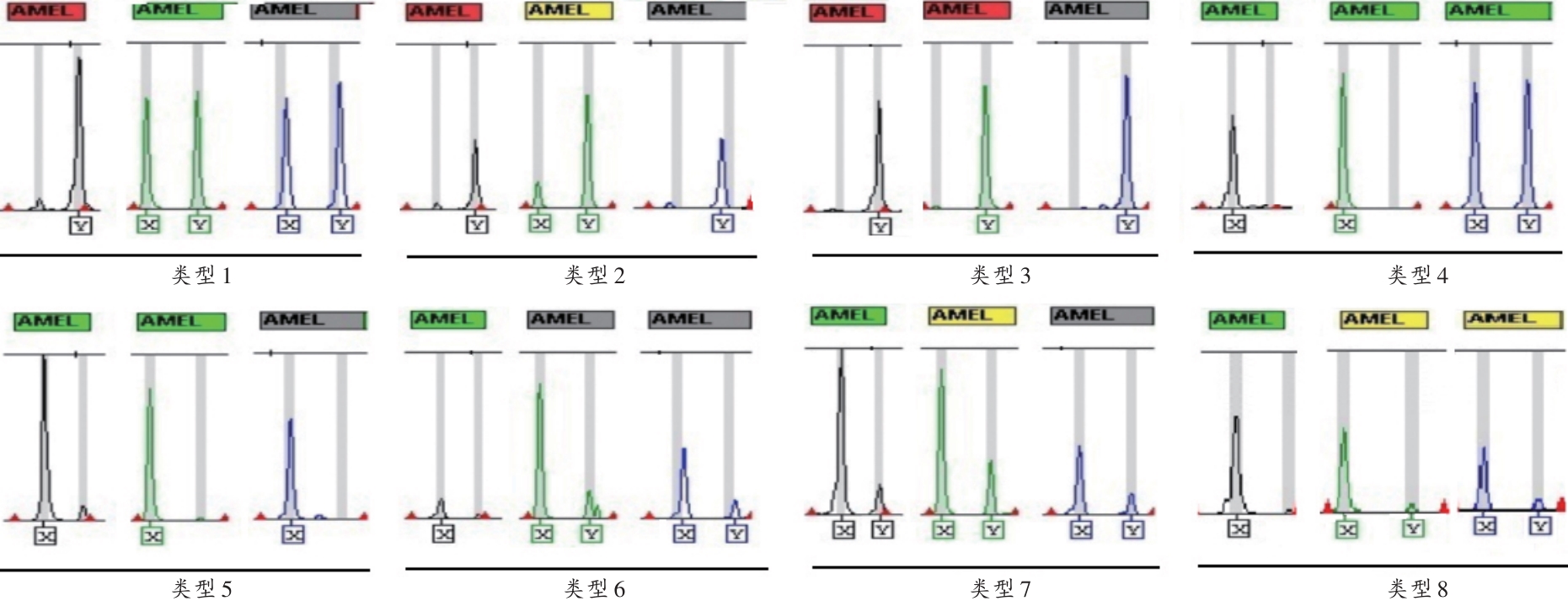
Fig. 1 Eight types of abnormal genotyping at Amelogenin locus
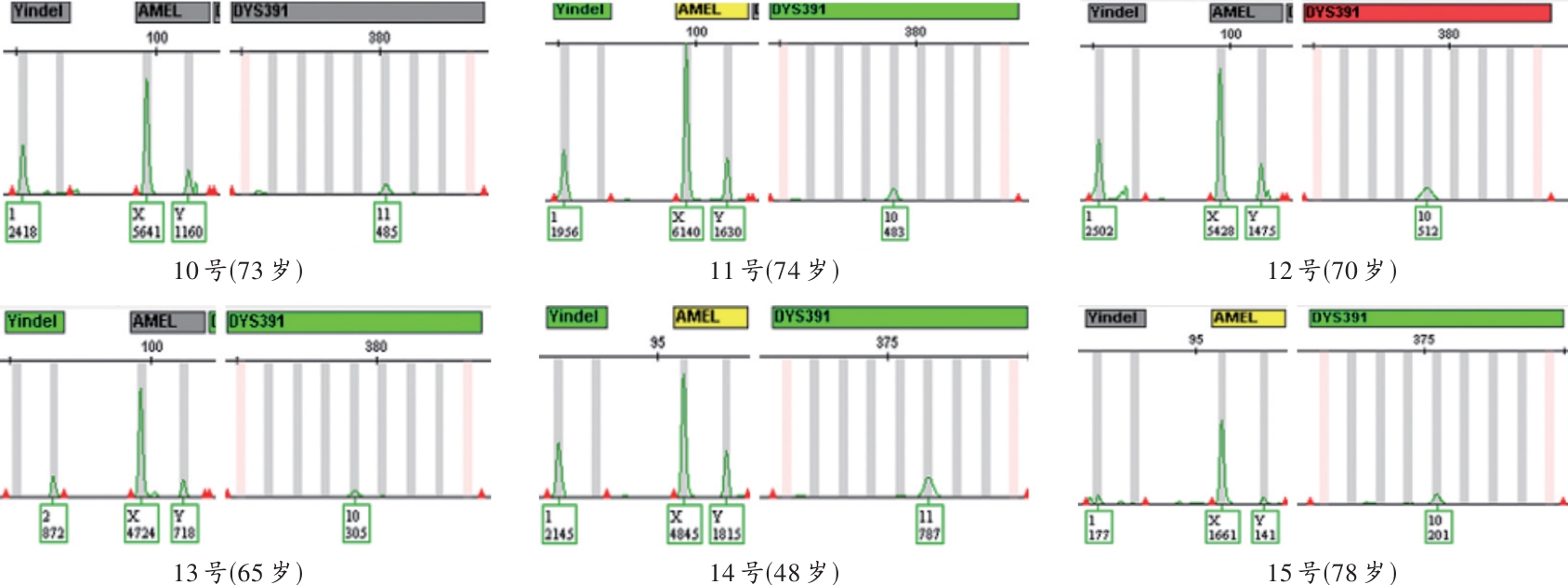
Fig. 2 Genotyping results of Amelogenin,Y-InDel and DYS391 loci in 6 samples detected by the GlobalFilerTM kit

Fig. 3 Base mutation positions confirmed by Sanger sequencing in representative samples
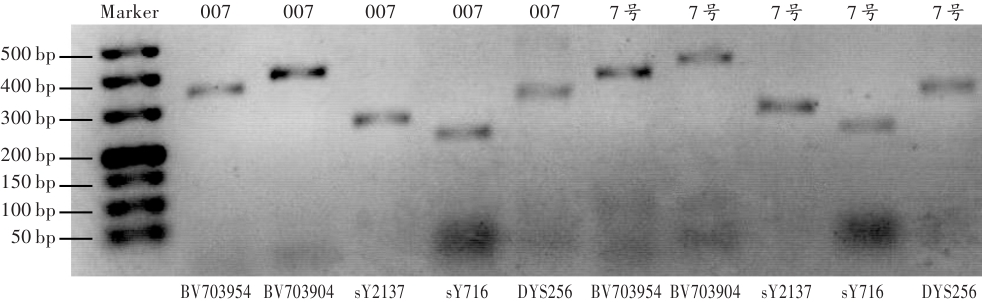
Fig. 4 Amplification results of 5 STSs in sample 7
| [1] | HAAS-ROCHHOLZ H, WEILER G. Additional primer sets for an Amelogenin gene PCR-based DNA-sex test[J]. Int J Legal Med,1997,110(6):312-315. doi:10.1007/s004140050094 . |
| [2] | SULLIVAN K M, MANNUCCI A, KIMPTON C P, et al. A rapid and quantitative DNA sex test: Fluorescence-based PCR analysis of X-Y homologous gene Amelogenin [J]. Biotechniques,1993,15(4):636-638,640-641. |
| [3] | 黄江平,杨帆,刘亚楠,等. 性别鉴定中Amelogenin基因座变异的研究进展[J].法医学杂志,2016,32(5):371-377. doi:10.3969/j.issn.1004-5619.2016.05.013 . |
| HUANG J P, YANG F, LIU Y N, et al. Research progress on gene alterations of Amelogenin locus in gender identification[J]. Fayixue Zazhi,2016,32(5):371-377. | |
| [4] | 庞潜潜,侯秀迪,金艺玲,等. AMELY无效扩增个体Yp11.2区域STS位点检测[J].中国法医学杂志,2021,36(2):158-161. doi:10.13618/j.issn.1001-5728.2021.02.009 . |
| PANG Q Q, HOU X D, JIN Y L, et al. Detection mapping of Y chromosome STS loci in AMELY dropout individuals[J]. Zhongguo Fayixue Zazhi,2021,36(2):158-161. | |
| [5] | BUTLER J M. 法医DNA分型专论:证据解释[M]. 侯一平,李成涛,严江伟,译. 北京:科学出版社,2018:76. |
| BUTLER J M. Advanced topics in forensic DNA typing: Interpretation[M]. HOU Y P, LI C T, YAN J W, transl. Beijing: Science Press,2018:76. | |
| [6] | 张家硕,李学博,乔路,等. 男性个体Amelogenin基因座X等位基因缺失5例[J].法医学杂志,2022,38(3):440-442. doi:10.12116/j.issn.1004-5619.2020.500401 . |
| ZHANG J S, LI X B, QIAO L, et al. X allele deletion at the Amelogenin locus in male individuals: Five case reports[J]. Fayixue Zazhi,2022,38(3):440-442. | |
| [7] | 毕洁,畅晶晶,余纯应. 疑似Amelogenin等位基因丢失的检测与分析12例[J].法医学杂志,2018,34(4):396-400. doi:10.12116/j.issn.1004-5619.2018.04.011 . |
| BI J, CHANG J J, YU C Y. Detection and analysis of 12 suspected Amelogenin allelic loss cases[J]. Fayixue Zazhi,2018,34(4):396-400. | |
| [8] | JOBLING M A, LO I C C, TURNER D J, et al. Structural variation on the short arm of the human Y chromosome: Recurrent multigene deletions encompassing Amelogenin Y[J]. Hum Mol Genet,2007,16(3):307-316. doi:10.1093/hmg/ddl465 . |
| [9] | MITCHELL R J, KRESKAS M, BAXTER E, et al. An investigation of sequence deletions of Amelogenin (AMELY), a Y-chromosome locus commonly used for gender determination[J]. Ann Hum Biol,2006,33(2):227-240. doi:10.1080/03014460600594620 . |
| [10] | STEINLECHNER M, BERGER B, NIEDERSTÄTTER H, et al. Rare failures in the Amelogenin sex test[J]. Int J Legal Med,2002,116(2):117-120. doi:10.1007/s00414-001-0264-9 . |
| [11] | OU X L, CHEN W J, CHEN H, et al. Null alleles of the X and Y chromosomal Amelogenin gene in a Chinese population[J]. Int J Legal Med,2012,126(4):513-518. doi:10.1007/s00414-011-0594-1 . |
| [12] | ALVES C, COELHO M, ROCHA J, et al. The Amelogenin locus displays a high frequency of X homologue failures in São Tomé Island (West Africa)[J]. Int Congr Ser,2006,1288:271-273. doi:10 . |
| 1016/j.ics.2005.10.036. | |
| [13] | SHADRACH B, COMMANE M, HREN C, et al. A rare mutation in the primer binding region of the Amelogenin gene can interfere with gender identification[J]. J Mol Diagn,2004,6(4):401-405. doi:10.1016/S1525-1578(10)60538-7 . |
| [14] | MACIEJEWSKA A, PAWŁOWSKI R. A rare mutation in the primer binding region of the Amelogenin X homologue gene[J]. Forensic Sci Int Genet,2009,3(4):265-267. doi:10.1016/j.fsigen.2009.01.010 . |
| [15] | MULERO J, GREEN R, LAGACE R, et al. Ame-logenin SNP on chromosome X: US 2011/0237443 A1[P]. 2011-09-29. |
| [16] | 宋佳辉,刘振平,张晓霞,等. STRtyper-21G分型数据库同一性比对容差分析[J].中国法医学杂志,2025, 40(4):434-437. doi:10.13618/j.issn.1001-5728.2025.04.009 . |
| SONG J H, LIU Z P, ZHANG X X, et al. Mismatch analysis of individual identity alignments from STRtyper-21G DNA-typing database[J]. Zhongguo Fa-yixue Zazhi,2025,40(4):434-437. | |
| [17] | CHEN W J, WU W W, CHENG J D, et al. Detection of the deletion on Yp11.2 in a Chinese population[J]. Forensic Sci Int Genet,2014,8(1):73-79. doi:10.1016/j.fsigen.2013.07.003 . |
| [18] | TAKAYAMA T. A novel mutation at the AMEL primer binding region on the Y chromosome in AMELY negative male[J]. Int J Legal Med,2022,136(2):519-526. doi:10.1007/s00414-022-02781-6 . |
| [19] | 翁玮霞,刘彩虹,刘超,等. 性反转综合征染色体和DNA分析1例[J].中国法医学杂志,2017,32(2):209-211. |
| doi:10.13618/j.issn.1001-5728.2017.02.030.WENG W X, LIU C H, LIU C, et al. Chromosome and DNA analysis of sex reversal syndrome: A case report[J]. Zhongguo Fayixue Zazhi,2017,32(2):209-211. | |
| [20] | 陈芳,章红星,陈建红,等. 亲子鉴定中46,XX男性性反转1例[J].法医学杂志,2015,31(5):415-416. |
| doi:10.3969/j.issn.1004-5619.2015.05.030.CHEN F, ZHANG H X, CHEN J H, et al. 46,XX male sex reversal in paternity testing: A case report[J]. Fayixue Zazhi,2015,31(5):415-416. | |
| [21] | 王克杰,杨继全,武红艳,等. 男性样本Amel基因座Y片段引物结合区变异1例[J].中国法医学杂志,2012,27(6):501. |
| WANG K J, YANG J Q, WU H Y, et al. Variation in the primer binding region of the Y fragment at the Amel locus in a male sample[J]. Zhongguo Fayixue Zazhi,2012,27(6):501. | |
| [22] | BOROVKO S, SHYLA A, KORBAN V, et al. Amelogenin test abnormalities revealed in Belarusian population during forensic DNA analysis[J]. Forensic Sci Int Genet,2015,15:98-104. doi:10 . |
| 1016/j.fsigen.2014.10.014. | |
| [23] | 刘振平,童继军,翟仙敦. 多个Y-STR等位基因缺失及AZF分析[J].刑事技术,2024,49(5):480-484. doi:10.16467/j.1008-3650.2023.0076 . |
| LIU Z P, TONG J J, ZHAI X D. Detection of multiple Y-STRs allele dropout and AZF analysis[J]. Xingshi Jishu,2024,49(5):480-484. | |
| [24] | 赖力,薛士杰,金静君. 1例Turner患者Amelogenin和STR基因座分型及核型分析[J].中国法医学杂志,2011,26(6):485-486. doi:10.3969/j.issn.1001-5728.2011.06.020 . |
| LAI L, XUE S J, JIN J J. Typing of Amelogenin and STR loci and karyotype analysis in a patient with Turner syndrome[J]. Zhongguo Fayixue Zazhi,2011,26(6):485-486. | |
| [25] | 吴光富,夏家权. 一祖孙Amel-Y、DYS570、DYS576等位基因异常及分析[J].中国法医学杂志,2022,37(3):313-315. doi:10.13618/j.issn.1001-5728.2022.03.024 . |
| WU G F, XIA J Q. Analysis of abnormal alleles at Amel-Y, DYS570, DYS576 loci in a case involving a grandfather and grandson[J]. Zhongguo Fayixue Zazhi,2022,37(3):313-315. | |
| [26] | LAI L, HUANG X L, MEI D R, et al. Analysis of a Yp11.2 region deletion in a Chinese female with Turner syndrome: A case report[J]. Heliyon,2023,9(4):e15162. doi:10.1016/j.heliyon.2023.e15162 . |
| [27] | LAI L, HUANG X L, WANG Y C, et al. Detection and analysis of null alleles of Amelogenin in gender identification[J]. Leg Med (Tokyo),2021,52:101899. doi:10.1016/j.legalmed.2021.101899 . |
| [28] | 李嫣然,程丝,赵曼曼,等. Y染色体嵌合缺失与心脑血管疾病[J].中国卒中杂志,2023,18(2):175-179. doi:10.3969/j.issn.1673-5765.2023.02.006 . |
| LI Y R, CHENG S, ZHAO M M, et al. Mosaic loss of Y chromosome and cardio- and cerebrovascular diseases[J]. Zhongguo Cuzhong Zazhi,2023,18(2):175-179. | |
| [29] | DANIELSSON M, HALVARDSON J, DAVIES H, et al. Longitudinal changes in the frequency of mosaic chromosome Y loss in peripheral blood cells of aging men varies profoundly between individuals[J]. Eur J Hum Genet,2020,28(3):349-357. doi:10.1038/s41431-019-0533-z . |
| [30] | THOMPSON D J, GENOVESE G, HALVARDSON J, et al. Genetic predisposition to mosaic Y chromosome loss in blood[J]. Nature,2019,575(7784):652-657. doi:10.1038/s41586-019-1765-3 . |
| [31] | SONG M Y, JIANG L R, WANG X D, et al. Loss of Y chromosome in leukocytes can be regarded as a male-specific age predictor for age group estimation in forensic genetics[J]. Mol Genet Genomics,2023,298(5):1073-1085. doi:10.1007/s00438-023-02039-9 . |
| [32] | KUZNETSOVA I L, URALSKY L I, TYAZHELOVA T V, et al. Mosaic loss of the Y chromosome in human neurodegenerative and oncological diseases[J]. Vavilovskii Zhurnal Genet Selektsii,2023,27(5):502-511. doi:10.18699/VJGB-23-61 . |
| [1] | Le YANG, He REN, Yan SHI, Chong CHEN, Li JIA, Qian YANG, Yacheng LIU, Jiangwei YAN. Empirical Classification of Tri-Allelic Genotype Cases and Parentage Index Calculation [J]. Journal of Forensic Medicine, 2026, 42(3): 254-260. |
| [2] | Gengqian ZHANG, Zidong LIU. Methods, Applications and Prospects of RNA Polymorphism for Individual Identification [J]. Journal of Forensic Medicine, 2026, 42(2): 143-150. |
| [3] | Jinyuan ZHAO, Yujia XUAN, Anqi CHEN, Yanfang LU, Mengxiao LIAO, Sitong LIU, Yu XING, Yali WANG, Liqin CHEN, Chengtao LI. Effect of RNA Sequencing Normalization on Forensic Age Estimation [J]. Journal of Forensic Medicine, 2026, 42(2): 112-120. |
| [4] | Yi-hua SUN, Jian CHEN, Yong-sheng LI. Comparison of the Forensic Testing Performance of Six STR Kits [J]. Journal of Forensic Medicine, 2026, 42(1): 26-33. |
| [5] | ZHU Bo-feng. Precision Identification from a Multi-omics Perspective: Current Status, Challenges, and Prospects in Forensic Genetics [J]. Journal of Forensic Medicine, 2025, 41(5): 421-440. |
| [6] | Jing CHEN, Ya-ping WANG, Yun-peng FENG, Xiao-xin HU, Zhen-jun JIA, Hong-di LIU, An-xin YAN, Yong-jiu LI, Zhu PENG, Zhi-fang LIU, Jian-gang CHEN. Validation and Forensic Application of a Domestic Human DNA Quantitative Detection Kit [J]. Journal of Forensic Medicine, 2025, 41(3): 252-259. |
| [7] | Ze-qin LI, Fang YUAN, Na LIU, Jiang-wei YAN, Geng-qian ZHANG. Dental Floss-derived Biological Sample Collection, DNA Extraction and STR Typing [J]. Journal of Forensic Medicine, 2025, 41(3): 237-243. |
| [8] | Bao-yan XIE, Ruo-cheng XIA, Ting-ting JIANG, Rui-yang TAO, Cheng-tao LI. Bibliometric and Visual Analysis of Forensic Research on Body Fluid Identification [J]. Journal of Forensic Medicine, 2025, 41(3): 217-227. |
| [9] | Yi-fan BAI, He-miao ZHAO, Jing CHEN, Hong-di LIU, Rui-qin YANG, Chong WANG. Application of Forensic Transcriptomics in the Identification of Tissue Origin of Body Fluid Stains [J]. Journal of Forensic Medicine, 2025, 41(3): 260-266. |
| [10] | Xi HE, Zhen TANG, Ming-ying XIA, Yi-qi ZHAO, Yu-ran LUO, Shi-lin LI. Analysis of Genetic Structure among Different Populations Based on 13 Auto-somal STR Loci in CODIS Core [J]. Journal of Forensic Medicine, 2025, 41(3): 228-236. |
| [11] | Gao-fang SHEN, Yong-song ZHOU, Jian-qiu ZHANG, Shi-you JI, Ying-feng WU, Hao SHANG, Bo-feng ZHU. Establishment and Application of TaqMan qPCR Detection Method for Human DNA Contamination in DNA Laboratory [J]. Journal of Forensic Medicine, 2025, 41(1): 66-73. |
| [12] | Jing LIU, Zheng WANG, Yi-ping HOU, Lin-chuan LIAO. The Impact of STR Mutations on Kinship Identification [J]. Journal of Forensic Medicine, 2024, 40(5): 484-491. |
| [13] | Jun-ping HAN, Ying-xi WANG, Chao LIU, Feng LIU, Jin-rong GUO, Wei ZHU, Guang-feng TANG, Cai-xia LI, Xin WANG, Zhang-ping JIAO. Test and Evaluation of the Made-in-China Quick TargSeq Fully Integrated Automated On-site Rapid DNA Detection Instrument [J]. Journal of Forensic Medicine, 2024, 40(5): 461-467. |
| [14] | Li-ming WU, An-qi CHEN, Su-hua ZHANG, Cheng-tao LI. Identification Methods of Tumor Tissue Origin Based on Different STR Typing Kits [J]. Journal of Forensic Medicine, 2024, 40(4): 330-339. |
| [15] | Ming-hui JIN, Ya LI, Shao-hua YI. Research Progress on the Application of Human Body Surface Microbiome to Forensic Individual Identification [J]. Journal of Forensic Medicine, 2024, 40(4): 379-386. |
| Viewed | ||||||
|
Full text |
|
|||||
|
Abstract |
|
|||||
